
Launching something new is exciting. It is also full of risk.
Teams often move fast because they need to. Budgets are committed, deadlines are fixed, and there is pressure to get into market. That is usually when assumptions start filling the gaps. Assumptions about demand, audience fit, pricing, packaging, messaging, or where the product will sit in people’s lives.
Research will not guarantee a successful launch. But it can stop avoidable mistakes. Done at the right time, and in the right way, it gives you clearer decisions and fewer surprises.
WHY GUESSWORK GETS EXPENSIVE
A lot of launch risk comes from confidence built on incomplete information.
Sometimes the product is right, but the messaging misses. Sometimes the proposition is strong, but the packaging does not land. Sometimes the price feels sensible internally, but not to the people you want to buy it. These are not small issues. Left untested, they can turn into expensive problems after launch.
This matters even more in crowded UK categories, where people make quick decisions and new brands have very little time to earn attention. If a launch is relying on shoppers to understand something unfamiliar, the margin for error gets smaller.
Research helps reduce that risk by showing where the friction is likely to sit before you commit fully. It does not need to answer every question. It needs to help you answer the right ones.
TEST WHAT WILL CHANGE A DECISION
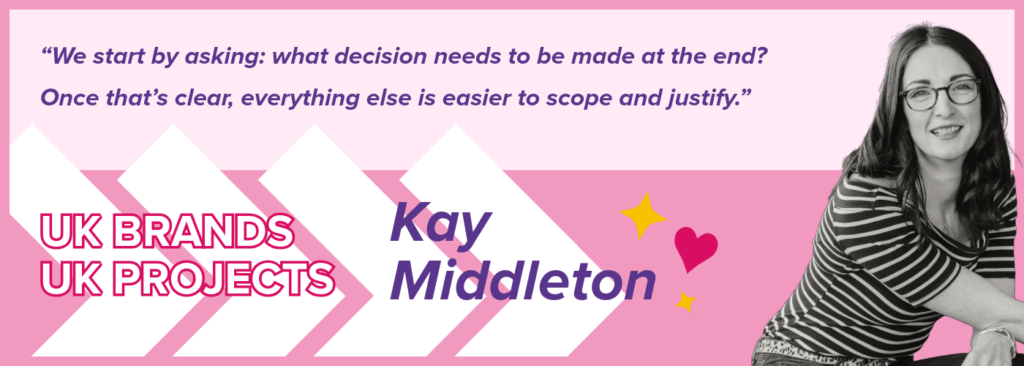
The most useful launch research is decision-led.
That usually means testing the things most likely to affect take-up, trial, and confidence in the launch. Proposition clarity is one. Can people quickly understand what this is, who it is for, and why it matters? Messaging is another. Are you landing the idea in a way that feels relevant and distinctive?
Pricing also matters. Not always in exact terms, but in how people judge value, quality, and worth. Then there are the barriers to trial. What is putting people off? What needs explaining? What feels unfamiliar, risky, or easy to ignore?
That is often the difference between research that informs a launch and research that simply adds to the paperwork.
WHEN TO RUN RESEARCH
Launch research is often commissioned too late. By the time it starts, core decisions have already been made and the room for change is small. A better approach is to use research at key moments, with each stage answering a different type of question.
Early concept work can help pressure-test the idea itself. Does the proposition make sense? Does it feel needed? Is there a clearer or stronger route into the market?
Pre-launch validation helps sharpen the execution. This is where messaging, packaging, product expectations, pricing cues, and barriers to trial can be explored before budget is fully committed.
Then there is post-launch learning. What happened in market? What did people understand, miss, or react to differently than expected? Those learning loops can be just as important as the launch work itself, especially if the ambition is to build, adapt, and scale.
SPEED AND EVIDENCE CAN COEXIST
Research does not have to slow a launch down.
The key is to be proportionate. Not every launch needs a large, complex programme. Sometimes a focused qualitative stage is enough to show where the biggest risks sit. Sometimes a quick product test, digital community, accompanied shop, or short set of online groups will give you enough direction to make a better decision.
What matters is being clear about what you need confidence on, and what level of evidence is enough to move forward.
For one emerging UK soft drink challenger brand, early-stage research helped explore taste, design, ethics, and ingredient preferences among younger consumers before a wider push. A second stage then tested product experience more deeply with selected participants. The work gave the team clear direction on packaging and branding design, and supported an important international pitch. The value was not in researching everything. It was in testing the areas most likely to shape the launch story.
WHAT “ENOUGH” RESEARCH LOOKS LIKE
Good launch research should reduce meaningful risk. It should help you understand what needs changing, what is working, and what needs more confidence behind it. It should not create delay for the sake of completeness.
That is especially true for founders and marketing leaders balancing momentum with budget. The aim is not to over-engineer the process. It is to avoid going to market with preventable blind spots.
A strong example of this came from a study designed to help establish an Asian snack brand in the UK. The work combined pre-task exploration, in-home product testing, online groups, and accompanied shops to understand how UK grocery shoppers viewed products in the world food aisle. The research uncovered practical barriers around packaging, shelf context, and shopper confidence, while also identifying opportunities in proposition and product appeal. That gave the client clearer footing, not only for product and brand development, but also for conversations with potential stockists.
DE-RISKING WITHOUT LOSING MOMENTUM
The best launch research does not sit on the sidelines. It helps teams move with more confidence.
That might mean refining your proposition before it hardens. It might mean improving messaging before it reaches a wider audience. It might mean testing enough to build senior buy-in and make rollout decisions easier across the business.
The point is not to remove all uncertainty. That is not realistic.
The point is to reduce the avoidable risk, so the launch is built on stronger ground.
If you are planning a UK product or brand launch and want to reduce risk without slowing momentum, we can help scope the right research.
To get off the launchpad, just GET IN TOUCH