
International recruitment can look simple from a distance. You define the audience, agree the markets, translate the screener, find the participants, and field the research.
In reality, there is much more to it.
Different markets bring different behaviours, expectations, recruitment routes, privacy concerns, incentive norms, response patterns, and cultural cues. A recruitment approach that works beautifully in one country may need careful adjustment in another.
At BEAM, we believe good international recruitment is not about hoping every market behaves the same. It is about knowing what can go wrong and planning properly before it does.
THE BRIEF IS UNCLEAR
Many recruitment issues begin before recruitment starts.
If the audience definition is too broad, too vague, or too open to interpretation, each market may recruit a slightly different version of the participant.
That can create serious problems later. The sample may look complete on paper, but the insight becomes hard to compare. One market may have highly engaged category users, while another has lighter users. One market may interpret a purchase frequency differently. One may treat job titles or household roles in a way that does not match the client’s expectations.
The prevention is simple, but important: align the audience before launch.
That means agreeing must-have criteria, nice-to-have criteria, exclusion rules, evidence requirements, terminology, and what a good participant sounds like in conversation. Where possible, we also look at market feasibility before finalising the sample.
A clear brief gives every market the same target.
TRANSLATION CHANGES MEANING
Translation is not just language conversion.
A screening question can technically be translated correctly and still lose meaning. Category terms, income bands, job roles, product claims, purchase channels, and behaviour descriptions may not map neatly between markets.
This can lead to participants qualifying in one country for reasons that would not qualify them in another.
To prevent this, screeners need market review, not just translation. Local teams should be encouraged to flag anything that feels unnatural, unclear, or culturally specific. The central project team then needs to decide how to adapt while protecting the original research objective.
This is where one clear point of contact matters. Adaptations should be agreed, documented, and shared, not made quietly in isolation.
THE AUDIENCE IS TOO NICHE
International recruitment can become difficult when a brief combines too many hard criteria.
A participant may need to live in a specific location, use a specific product, hold a specific job role, make a specific decision, have purchased within a specific time frame, and be willing to attend a particular method. Each requirement narrows the pool.
This does not mean the brief is impossible. It means feasibility needs to be honest.
In our luxury cross-market work, the audience was highly specific: recent purchasers of premium fashion in London and New York. Recruitment needed discretion, verification, and a tone that felt right for the audience. In our automotive work, company car owners, fleet managers, and key account managers needed to be verified, engaged, and suitable for a travel-based research experience.
Niche recruitment is possible, but it needs enough time, the right channels, clear verification, and realistic expectations.
Read our FASHION RESEARCH CASE STUDY here.
VERIFICATION IS WEAK
International projects can suffer when participants are accepted too quickly.
Claimed behaviour is useful, but it is not always enough. Depending on the brief, we may need proof of purchase, ID validation, product ownership evidence, role confirmation, location checks, or live screening calls.
Weak verification can affect the whole project. Clients may lose confidence. Moderators may notice gaps in experience. Market comparisons may become unreliable.
The prevention is to build verification into the recruitment design from the beginning.
Verification should feel proportionate. Not every project needs heavy documentation, but every project needs a clear answer to one question: how will we know participants are genuinely right for this research?
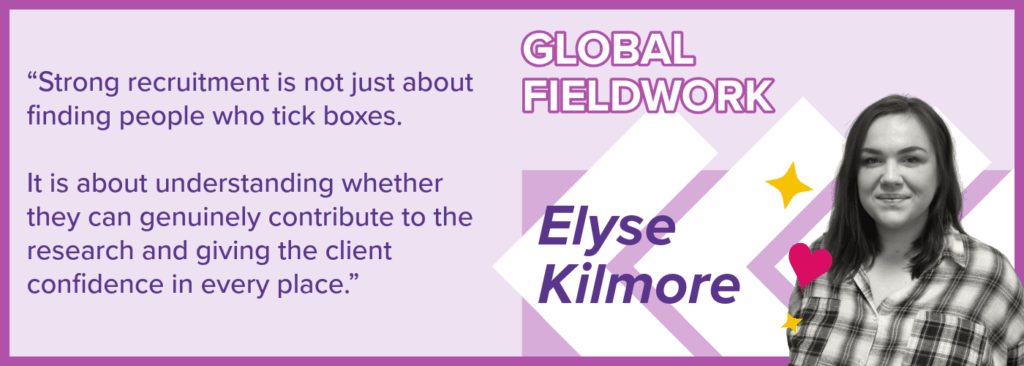
As Elyse Kilmore, Senior Project Manager, says:
INCENTIVES MISS THE MARK
Incentives vary by market, audience, method, and expectation.
An amount that feels generous in one country may not motivate the same audience elsewhere. Payment method can also matter. Some participants may expect direct bank transfer, others may be used to vouchers, and others may need reassurance about when and how payment will be made.
If incentives are not right, recruitment slows, drop-out rises, and participant trust can be affected.
Prevention starts with local advice. We look at audience difficulty, session length, preparation requirements, travel, sensitivity, and market norms. We also communicate incentive terms clearly, including timing, method, and any required payment details.
A good incentive does not buy an opinion. It recognises time, effort, and commitment.
COMMUNICATION DROP OFF
Global recruitment often involves longer timelines, especially when venues, travel, or client attendance are involved.
A participant who is excited at recruitment can become uncertain two weeks later if they have heard nothing. This is especially true for complex methods such as in-home interviews, fly-ins, car clinics, or sensitive topics.
To prevent this, participant management should continue after confirmation.
In our donor insights project, the briefing took place eight weeks before fieldwork. We built a weekly contact structure to keep participants informed, reassured, and engaged. This helped protect attendance and supported a sensitive research experience.
Confirmed does not mean complete. Good communication keeps commitment alive.
LOCAL RISKS ARE MISSED
Every market has its own practical realities.
Public holidays, weather, transport disruption, local events, school schedules, venue access, privacy expectations, and recruitment channel performance can all affect fieldwork.
These risks are often predictable if someone asks early enough.
Prevention means listening to local teams and asking practical questions before timelines are locked. It also means creating contingency plans. Over-recruitment, reserve participants, flexible session windows, alternative venues, and earlier check-ins can make all the difference.
International recruitment should feel controlled, not fragile.


THE BEAM VIEW
Things can go wrong in international recruitment. That is not a failure. It is the nature of working across markets, cultures, audiences, and methodologies.
The real measure is whether those risks have been anticipated and managed.
At BEAM, we prevent recruitment problems through clear briefing, market feasibility, careful screening, proportionate verification, participant care, strong communication, and joined-up project management.
We do not expect every market to behave the same. We expect every market to be managed to the same standard.
That is how global recruitment becomes reliable, human, and insight-ready.
If your international recruitment brief feels complex, niche, sensitive, or hard to compare across markets, we can help shape a process that protects quality from the start.
Let’s talk
If your global recruitment brief feels complex, niche, sensitive, or hard to compare across markets, we can help shape a process that protects quality from the start. GET IN TOUCH…