
When a project involves a broad consumer category but very specific behaviour patterns, the real challenge sits beneath the surface.
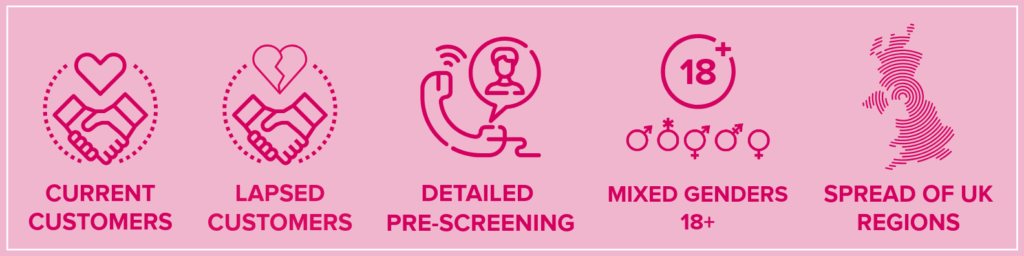
For this study, we led recruitment and fieldwork for a leading UK coffee brand preparing to relaunch its loyalty programme. The brief called for active and lapsed loyalty customers, tightly managed quota layers, detailed screening and genuine, discussion-ready respondents across both face-to-face and online groups.
THE BACKGROUND
We supported a leading high street coffee brand as it prepared to relaunch its loyalty programme. The research focused on current and lapsed rewards card customers.
THE AIM: to understand how people engage with the brand
– What drives usage?
– Where do friction or drop-off appear?
– What does the customer journey look like?
At first glance, this looked like a broad audience. However, the real challenge sat in the detail. The sample needed to reflect not just coffee buyers, but very specific types of loyalty users and non-users across multiple quota layers.
THE BRIEF
Our role was to lead recruitment and fieldwork for a series of focus groups designed to explore customer attitudes ahead of the relaunch.
The brief required us to find a highly specific mix of participants, including people who held a rewards card but had not used it in the last three months. This group proved especially hard to source.
The client also needed confidence that every respondent was genuine, well-screened, and able to contribute meaningfully in discussion. That meant quality control mattered just as much as speed.
THE APPROACH
We approached the project with a strong emphasis on precision, validation, and flexibility.
First, we mapped the full quota structure in detail. This helped us track interdependencies across brand preference, beverage choice, purchasing behaviour, frequency, and demographic splits. In projects like this, good recruitment is not only about filling seats. It is about protecting the mix inside the room so the discussion delivers useful contrast and depth.
Next, we carried out multiple targeted searches through Give Opinions. Where needed, we also worked with trusted recruitment partners to help identify the final niche profiles. This gave us broader reach without lowering the quality bar.
We then put every potential participant through a detailed follow-up telephone screening and Q&A process. This step helped us assess whether people were genuine, whether their behaviour matched the brief, and whether they were likely to engage well in a group setting. It also helped us reduce the risk of professional respondents or people stretching the truth to qualify.
FIELDWORK DELIVERABLES
We delivered a full recruitment and fieldwork package, managing both the practical delivery of the groups and the quality control needed to protect the final sample.
Including:
– 48 recruited participants across current and lapsed loyalty card segments
– 4 face to face focus groups in Central London
– 2 online focus groups across the UK, excluding London
– Controlled over-recruitment levels to protect attendance
– Daily project status logs throughout delivery
– Secure transfer of project data via Agency Portal
– Full recruitment and fieldwork delivery within a 4-week timeline from screener sign-off to first sessions
END-TO-END MANAGEMENT
We managed this project closely because the recruitment challenge was likely to evolve as live incidence became clearer.
We kept the client team updated through daily status logs. This meant the agency had a clear view of progress, pressure points, and any quota areas needing extra attention. That visibility helped reduce uncertainty and supported faster decisions when priorities shifted.
We also managed participant quality carefully throughout. In practice, this meant checking not only eligibility, but also clarity of communication, level of interest, and ability to reflect on their own experience. For qualitative work, that matters. A technically eligible participant is not always the right participant.
Secure data handling was built into the process from the outset, with all transfers completed through a secure agency portal.
SUCCESSFUL OUTCOMES
The project delivered a well-balanced sample across a difficult set of interlocking quotas.
Most importantly, we were able to source respondents from a narrow and often overlooked behavioural segment: people who still held a rewards card but had not used it recently. That gave the research team access to voices that were central to the brief, but harder to reach than initial audience definitions suggested.
Our screening process also helped protect the integrity of the sample. By taking time to validate responses through detailed follow-up calls, we improved confidence in participant authenticity and suitability.
The result was a set of groups that gave the client robust, discussion-ready insight ahead of an important programme relaunch.
BEAM IN ACTION
What made the difference here was not one single tactic. It was the combination of structured quota management, active sourcing, and careful human screening.
On paper, this audience looked accessible. In reality, the brief required a very specific mix of behaviours that sat within a wider general population audience. That is often where projects become risky. The audience appears broad, but the qualifying logic is narrow.
We responded by staying close to the live recruitment picture. As patterns emerged, especially around the low incidence of genuine lapsed card users, we adapted sourcing routes and kept quality checks high. Rather than forcing recruitment through one channel, we widened the search while maintaining the same screening standard.
This is where experienced fieldwork adds value. It is not only about filling the sample. It is about understanding where the real recruitment risk sits, then adjusting early enough to keep the project on track.
THE RESULT
We delivered all groups within the required timeline and with the right participant mix in place.
The research team was able to speak with both active and lapsed loyalty customers, including a segment that had proved harder to identify than expected. This created a stronger foundation for understanding how the loyalty scheme was being used, where engagement was dropping, and what the relaunch needed to address.
The operational outcome was clear: a complex recruitment brief was delivered successfully through careful sourcing, strong screening, and disciplined project management.
THE LEARNING
The biggest learning from this project was simple: a high incidence category does not always mean an easy recruitment.
Coffee buyers are easy to find. Genuine loyalty card holders with very specific usage patterns are not. In this case, the most valuable segment sat between two more obvious groups: highly engaged users and people with little awareness of the card at all. That middle group was smaller and harder to validate.
For us, this reinforced the value of early behavioural testing in screeners and of keeping manual screening at the centre of qualitative recruitment. When eligibility depends on a subtle pattern of behaviour, online applications alone are rarely enough. The telephone screening stage was critical in confirming authenticity, clarifying answers, and selecting participants who would contribute well.
This project also strengthened a process we continue to use: when a brief includes niche behavioural quotas inside a broad audience, we plan for multi-source recruitment from the outset. That gives us more control, helps reduce late-stage risk, and improves the quality of the final sample.
In short, the learning was not only about how to find the right respondents. It was about how to recognise hidden complexity early, then build a recruitment process that protects insight quality at every stage.
If your project depends on finding the right people within a hard-to-reach behavioural segment, WE CAN HELP.
We combine careful recruitment, strong screening, and hands-on project management to keep complex qualitative work moving with confidence.
Back to Case StudiesLet BEAM Fieldwork support your research project. Fill in the contact form below
or give us a call on 0161 850 9864