
When a project involves a broad consumer audience but an evolving target profile, the real challenge sits beneath the surface.
A growing UK drinks brand came to us looking for clarity before taking a new product to market. They believed in the product and its potential, but needed a sharper understanding of who the target customer really was, how the product should be positioned, and how to present it more confidently to retailers.
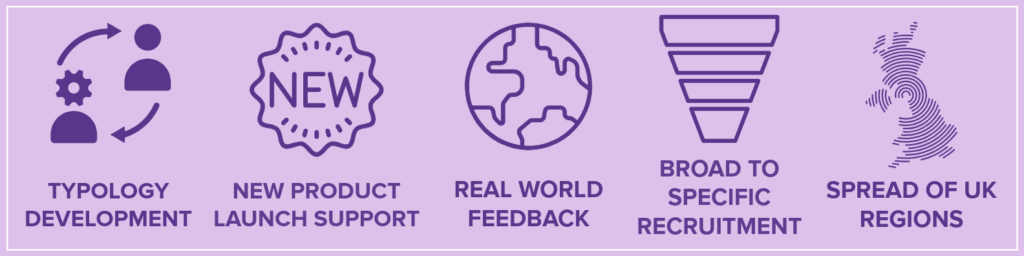
We were brought in to support a staged research project designed to help a drinks company better understand and define its customer base ahead of a new product launch.
At the start, the client had strong belief in the opportunity, but some important questions were still open. Packaging design, practicality, target audience, and the retail pitch all needed clearer direction. The client was also less familiar with market research, so the process needed to do two things at once: generate robust insight and provide clear guidance at every stage.
The aim of the research was to identify the brand’s most relevant target customer and support the development of a clear mission statement.
That insight would help the client approach retailers with a stronger proposition, a better understanding of where the product fits, and a more confident plan for launch.
To get there, the project was designed in three stages, moving from broad audience exploration to more focused, real world product testing:
– Stage 1: 300 participants recruited for a quant and typology-defining exercise
– Stage 2: 96 of the original 300 selected for a deeper dive using WhatsApp
– Stage 3: 24 of the 96 selected for a shop and test mission
This staged design allowed the audience to narrow as the learning developed, helping the client move from assumption to evidence.
We built the project around a staged recruitment and fieldwork model that allowed the insight to deepen as the audience became more defined.
In Stage 1, we recruited 300 participants for a dual-purpose exercise. This acted as both a quant usage and attitude survey and a recruitment screener for the next stages. The survey was distributed to Give Opinions’ proprietary panel of more than 36,000 verified market research respondents. The goal was to align responses with the client’s expected customer profiles, while also allowing for a UK nationally representative fallback if needed.
In Stage 2, we moved into a hybrid qual and quant approach using a mobile optimised WhatsApp survey. Up to 80 participants took part, capped by quota, with one linear survey used across all participants. The survey included a mix of question types, including selected responses, written answers, selfie videos, and photo responses. This gave the client a richer view of behaviours, attitudes, and reactions in a format that felt natural and accessible for participants.
In Stage 3, the research became even more targeted. A smaller group took part in a shop and test mission, visiting their local B&M to review the coffee aisle experience, purchase two products, and test them at home. One flavour was predetermined, while the second was chosen by the participant. This phase also used a mobile optimised WhatsApp survey, combining written answers, image uploads, and selfie videos to capture realistic feedback rooted in actual purchase behaviour.
This approach was especially valuable because the product was only stocked in B&M. In the earlier stages, participants did not need to buy or even access the product physically, which kept the research broad and inclusive. In the later stages, we narrowed the sample to people who could realistically find, buy, and test the product, which made the final feedback more commercially useful.
We delivered a multi-stage programme that combined broad audience exploration with more focused, behaviour-led product testing. Each stage was designed to build on the last, helping the client move from early audience definition to more practical, purchase-based feedback.
Key deliverables included:
– 300 participants for a quant and typology-defining exercise
– 96 participants for a WhatsApp-based deeper dive
– 24 participants for a shop and test mission
Alongside this, we managed a dual-purpose survey, mobile first fieldwork through WhatsApp, staged participant selection, and a real world store visit and in-home product testing phase. The result was a structured but flexible fieldwork programme that gave the client both breadth and depth.
This project needed careful management throughout, not only because of the staged design, but because the client was less familiar with how market research works in practice.
That meant our role was not just to recruit and deliver fieldwork. We also needed to explain the reasoning behind the approach, guide the client through each stage, and keep communication clear and reassuring throughout.
The timings were tightly managed across the full programme:
– Stage 1: 12 to 14 days for data collection, plus 2 to 3 days for typology and recruitment work
– Stage 2: 5 to 7 days
– Stage 3: 5 days
Operationally, this kind of project relies on strong sequencing. Each phase needed to generate learning that could shape the next. Good project management here meant more than keeping to timeline. It meant keeping the process understandable, practical, and adaptable for everyone involved.
That was particularly important when balancing client needs with participant realities. Because the product had limited retail availability, we had to make sure the later stages only included people who could realistically access the product in store. That protected the quality of the feedback and kept the final insight grounded in real purchase behaviour rather than hypothetical opinion.
The staged design gave the client a clearer, more evidence-based understanding of who the product was most relevant for and how it should be positioned.
For the client, the outcome was a much stronger view of:
– Who the target customer really is
– What messaging and positioning would resonate most strongly
– How packaging and product practicality were being interpreted
– How to build a more confident retail pitch
For participants, the design made the research feel accessible and relevant. Early stages reduced barriers by allowing people to take part without needing immediate store access or purchase intent. Later stages focused on those who could realistically buy and test the product, which made the feedback more meaningful.
For the wider commercial objective, the insight helped the brand move towards retailer conversations with a clearer proposition and a better grounded launch plan.
What made this project work was the combination of flexibility, structure, and clear communication.
The differentiator was not simply the number of participants or the number of stages. It was the way the project was designed to evolve as learning emerged. Rather than forcing the research to follow a fixed assumption about the target audience, we allowed the audience profile and recruitment focus to sharpen as each stage revealed more.
That matters operationally. Inside BEAM, good fieldwork is about making sure the method works in the real world.
In this case, that meant:
– Starting broad enough to challenge early assumptions
– Narrowing the audience based on evidence rather than instinct
– Removing participation barriers in early stages
– Building later stages around realistic product access
– Buiding a less research-experienced client with clear explanation throughout
This approach reduced risk in several ways. It protected against overcommitting too early to the wrong audience. It improved participant relevance at each stage. It also ensured the final recommendations were rooted in behaviour rather than theory.
The project gave the client a stronger commercial foundation for launch. It helped move the conversation on from what the product could be, to who it was really for and how it should show up in the market. That clarity was valuable not just for the research itself, but for the practical decisions that followed around packaging, positioning, and retailer engagement.
The staged model kept the project moving while allowing room for learning between phases. Each stage had a clear purpose and timeframe, which helped maintain momentum without losing focus.
By starting broad and narrowing gradually, the client was able to invest more deeply only where the learning justified it. That made the process more efficient and reduced the risk of spending heavily on the wrong audience or the wrong line of questioning.
The final insight was more useful because it was built progressively. Rather than relying on a single snapshot, the client gained a layered understanding of customer fit, category behaviour, and real world product interaction.
This gave them clearer direction on positioning, packaging decisions, and retailer conversations.
The biggest learning from this project was the importance of building flexibility into both research design and delivery.
At the outset, there was an assumed target customer in mind. However, the staged approach showed that the most relevant audience can shift once real feedback starts to come through. By beginning with a broad audience and narrowing at each stage, we moved beyond assumption and identified the consumers who were genuinely most relevant to the product, the brand, and the retail opportunity.
This project also reinforced the value of adaptability in fieldwork. With a client who was less familiar with market research, clear communication and practical explanation were essential throughout. At the same time, participant access had to be managed carefully because the product was only available in specific stores.
The result was a process that stayed practical, focused, and insight-led from start to finish.
It has strengthened how we approach similar projects now. Where appropriate, we allow more room for audience profile, questioning, and recruitment priorities to evolve as the research develops, rather than forcing the project to fit assumptions made at the start. That leads to insight that is more meaningful, more commercially useful, and better able to support launch decisions.
If you need research recruitment that can flex as your understanding grows, we can help.
At BEAM, we build fieldwork around the realities of the brief, the audience, and the commercial decision behind it. Whether you need broad audience definition, staged consumer insight, or real world product testing, we help turn uncertainty into something more usable.
Back to Case StudiesLet BEAM Fieldwork support your research project. Fill in the contact form below
or give us a call on 0161 850 9864