
While rummaging through ten years of BEAM project history for our anniversary celebrations, we stumbled across something rather interesting.
Back in 2016, when BEAM was barely out of the starting blocks, we recruited three vloggers for a research project. Vloggers. Remember them?
Of course, they’re still around, although these days they’re more likely to introduce themselves as content creators. Back then, Instagram was still primarily a place to share photographs, TikTok hadn’t yet arrived in the UK, and making a living from posting videos online was a relatively unusual career choice.
It turns out we’ve been recruiting influencers for almost as long as we’ve been BEAM. We hadn’t quite appreciated that ourselves until we started digging through the archives.
Ten years later, the landscape looks rather different. We’ve recruited creators and specialist voices from the worlds of food, fashion, beauty, wellness, home organisation, motoring and plenty of places in between. We’ve encountered people with enormous followings, others with small but fiercely engaged communities, and a few whose specialist knowledge has left even our recruiters wondering whether they should be taking notes.
We’ve also discovered that some of the most interesting recruitment briefs involve people who are considerably harder to find than their social media presence might suggest.
And that, as it happens, is where the real work begins.
EVERYONE’S AN INFLUENCER
Well, not quite everyone. But there are certainly more varieties than there were ten years ago.
What began with bloggers, vloggers and early social media personalities has developed into an extraordinarily diverse world of creators, commentators, specialists and enthusiasts. Almost every interest imaginable now has its own online community, complete with people creating content for audiences who share their particular passion.
Food and fashion remain familiar territory for influencer research, but the briefs coming into BEAM have become increasingly specific.
We’ve been asked to find creators immersed in Korean skincare, people passionate about sustainable living, specialists in home organisation and wellness, and automotive enthusiasts whose knowledge extends well beyond knowing their way around a car.
More recently, we’ve encountered requests for petfluencers. Yes, people whose social media accounts are dedicated to their pets.
It’s tempting to think that the proliferation of online creators must make recruitment easier. After all, if everyone is posting about something, surely finding the right person is simply a matter of searching for the right hashtag?
If only.
A client might need someone who creates content about a particular subject, uses a specific platform feature, has an audience of a certain size and can demonstrate genuine expertise. They may also need to be independent of commercial relationships with the brands being researched, available for a face-to-face interview and willing to participate in something that doesn’t involve promoting a product to their followers. Suddenly, that enormous pool of potential participants starts looking rather smaller.
And before our recruitment team can start tracking them down, there’s an equally important question to answer.
Can we realistically deliver what the client is asking for?
BEFORE THE SEARCH EVEN STARTS
When an influencer recruitment enquiry lands at BEAM, there’s often more to consider than the number of participants, their demographics and the proposed research methodology. There’s the small matter of establishing whether the people described in the brief actually exist, whether they’re likely to participate and what it will realistically take to recruit them.
That’s where our quotation and project management teams come together.
Rather than developing a quotation in isolation and handing the project over once it’s commissioned, the RFQ manager works closely with the project manager most likely to deliver the research.
Together, they investigate potential recruitment routes, assess the feasibility of the participant criteria and consider how the project would work in practice. It’s an important collaboration, particularly when a brief involves specialist creators, highly specific online communities or people whose availability and incentive expectations are difficult to predict.
The team needs to understand how much time might be required to identify suitable creators, how they’ll be approached, what screening and verification will involve and how much resource will be needed to turn promising contacts into confirmed participants.
They also need to think about the practicalities of delivery, including scheduling, participant communications, travel arrangements and the possibility that some recruitment routes will prove less productive than expected.
Then comes the commercial balancing act.
Before we submit a quotation, we need a sensible understanding of how the proposed recruitment approach translates into costs. That means considering the time and resources involved, likely incentive expectations, potential third-party expenses and the amount of contingency a challenging brief might require. All while recognising that we may not yet know the client’s available budget.
As Kirsty, our Client Partnerships & Commercial Lead, explains
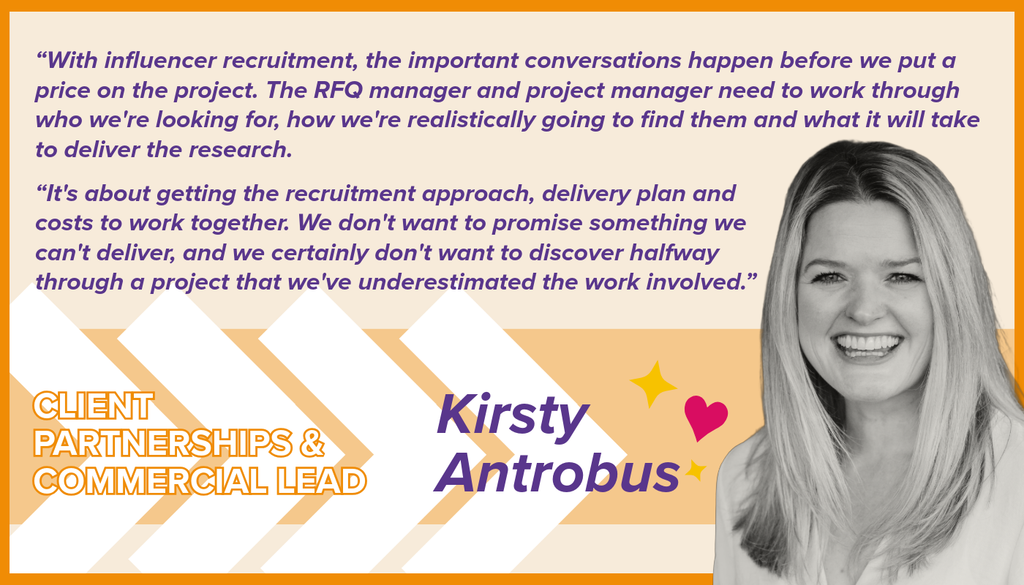
It’s a process that calls for experience, careful research and sometimes a willingness to challenge the original brief. Because a quotation isn’t simply a price attached to a recruitment specification. It’s a commitment to delivering the research.
And occasionally, working out how to make that commitment starts with a packet of cheesy snacks.
THE SUPERSNACK CHALLENGE
One particular brief has become something of a talking point among our team.
The client wanted content creators who were genuine superfans of a very familiar British snack. Think bright orange, cheese-flavoured, puffed corn curls, a household name that’s been leaving its mark on fingers and lunchboxes for generations. Not just people who enjoyed the occasional packet. Proper superfans. People with a genuine, demonstrable passion for this specific snack who were also active content creators with an established social media audience.
It sounded like an entertaining brief. We certainly weren’t short of enthusiasm for taking it on. But before committing to a quotation, our quotation and project teams decided to investigate whether the people being described were actually out there.
We started with the product itself, researching the range, variations, pack sizes and availability. Then they explored the brand’s marketing, advertising and PR activity, looking for the kinds of communities that often develop around well-loved consumer products. There wasn’t much to follow.
The snack didn’t have its own dedicated social media ecosystem, and there were no obvious extensions into clothing, merchandise or collectables that might help identify particularly devoted fans.
Retailer activity focused largely on supermarket promotions, multipacks and getting products into shopping baskets. All perfectly sensible ways to sell snacks. Less helpful when you’re trying to locate someone whose affection for one particular cheesy curl borders on devotion.
Next came social media.
We searched mentions, tags, photographs, videos, comments and anything else that might lead them towards people enthusiastically discussing the product. We followed the digital footprints, explored promising accounts and investigated the connections. Most trails led nowhere.
There was also a complication that isn’t always obvious when a brief first arrives.
Influencers who regularly feature a particular product often have some form of commercial relationship with the brand. They might have been paid to promote it, received products to review, been gifted merchandise or had contact with the brand following an earlier post.
None of that necessarily makes their enthusiasm insincere. But when the research requires people whose passion exists independently of brand activity, it can make them unsuitable.
Finding an established content creator who genuinely adored this one particular snack, had the right audience and wasn’t commercially connected to the brand was beginning to look like a hunt for unicorns.
We weren’t quite ready to give up on the unicorns, though. Instead, we started looking at the problem differently.
What if we began with genuine product enthusiasts, rather than established content creators?
Could we identify different levels of enthusiasm, understand how that translated into social media activity and build a recruitment approach around what we discovered? Our Give Opinions participant panel provided a useful place to start.
Using available UK research and demographic information, we identified a test audience likely to be active across social platforms, regularly consume snacks and live within reach of the proposed London research location. We also reviewed their previous engagement with research opportunities. Then we sent out a quick-fire survey.
The responses revealed plenty of people with strong feelings about products, brands, hobbies and experiences. There were fans of all sorts of things, many of them more than happy to share their enthusiasm. Finding people with that same level of devotion to our particular cheesy snack was another matter.
But the exercise gave us something far more useful than a list of social media accounts. It helped us understand how we might identify and assess genuine enthusiasm.
There’s a considerable difference between someone who says they love a snack and someone who can happily spend an hour explaining precisely why. So, we developed a proposed recruitment approach looking at these six different aspects of their relationship with the product. that distinguished between likers, lovers, fans and superfans, looking at these six different aspects of their relationship with the product.
Spotting Superfans
Amongst Likers, Lovers, & Fans
PRODUCT | Did their super snack match what was in our shopping basket?
CONSUMPTION | Were they a once a week eater or more than once a day muncher?
INVESTMENT | Did their kitchen cupboard or retailer receipts reveal their hunger habits?
EVIDENCE | How else could they showcase their commitment to these cheesy crisps?
ENGAGEMENT | Did social posts, profiles, feeds, followings and followers declare real devotion?
TALK THE TALK | Could they talk about the product with genuine passion and knowledge.
We adapted the original request to reflect what our investigations had uncovered when we submitted the RFQ response
BEYOND THE FOLLOWER COUNT
There’s a tendency to think of influencers in terms of numbers. Ten thousand followers. Fifty thousand. Half a million. The bigger the audience, the greater the influence.
For some projects, audience size is important. A client might specifically want to understand the experiences of creators operating at a particular level, or how the pressures and opportunities of content creation change as a following grows.
But follower counts alone tell us relatively little about the person behind the account.
Someone might be considered a micro-influencer on TikTok while having a substantially larger audience on Instagram. Without checking their wider online presence, it would be easy to place them in the wrong participant category. And an impressive following doesn’t necessarily mean someone has the knowledge, experience or communication skills that will make them valuable in a research session.
That’s why our recruitment team spend so much time getting to know the people behind the profiles. There’s plenty of investigation involved, or what one of our recruiters affectionately describes as a “good old snoop”.
We look across platforms, explore the content people create, check their experience and establish whether their online activity supports what they’re telling us. But some of the most revealing moments happen during screening conversations.
We regularly encounter creators whose knowledge goes far beyond what they’d expected. People who have spent years developing expertise, experimenting with products, understanding their communities and becoming genuinely immersed in their chosen subjects.
Alicia, our Senior Specialist Project Manager, particularly enjoys this part of the process…
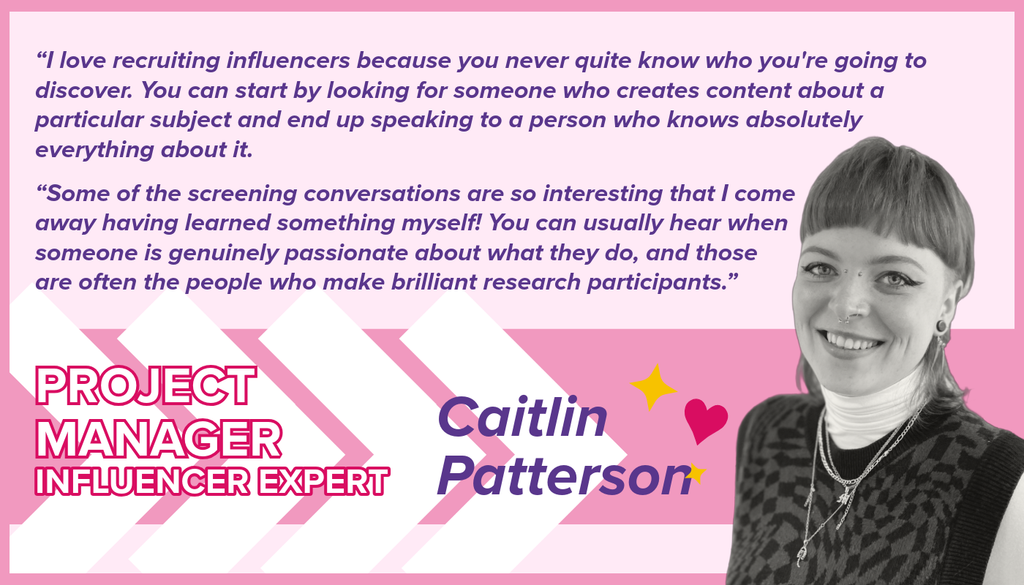
And then there’s personality.
A creator might tick the boxes on a recruitment specification, but someone who can speak naturally, enthusiastically and thoughtfully about their experiences brings something extra to a research session.
We have become particularly good at recognising that quality. Sometimes they can hear it almost immediately, in the way someone talks about their work or the enthusiasm that comes through when they’re describing something they care about. It’s one of the reasons we find influencer recruitment so interesting.
We’re not simply looking for people with audiences. We’re looking for people with something worth saying.
EXTRAORDINARY PEOPLE. EXTRAORDINARY INFLUENCE.
Of course, the real reward of looking beyond follower counts is discovering the extraordinary people behind the profiles. And over the past ten years, we’ve met some absolute crackers.
Take a project involving male plus-size fashion influencers. Among our recruits was a former athlete turned international model who’d travelled the world working with major fashion brands, yet still struggled to find clothes that fitted on the British high street. Another refused to promote clothing that didn’t fit properly, challenging brands to improve their designs rather than mislead his followers.
One creator recalled a fashion shoot where his T-shirt was cut open at the back to make it appear to fit. Hardly the authenticity he’d built his following around. And then there was a youth worker using fashion content to champion body positivity, helping young people feel more confident in their own skin.
Four creators from the same specialist category, but with remarkably different experiences, motivations and perspectives. Proof that influence isn’t always about selling something. Sometimes it’s about challenging an industry, changing attitudes or giving someone confidence.
And not everyone who influences a conversation has a social media following.
For a project exploring connections and connectivity, we searched for creative thinkers from entirely different worlds. Among them were a wine entrepreneur who’d travelled to 14 countries and established her own business by 25, a visual anthropologist combining cultural research with filmmaking and photography, and a professional opera singer who’d also built a career behind the camera.
Other briefs have challenged us to find equally contrasting personalities. For an ethical cola challenger, we were tasked with identifying a Great Britain Olympian with a global following, a breakout TikTok creator sharing life hacks and side-hustle advice, and a primetime regional radio personality with a growing social media audience. Three very different routes to influence, united by an interest in food, drink and global citizenship.
Sometimes our searches take us somewhere entirely unexpected.
Looking for automotive enthusiasts led us into competitive rallying and specialist motorsport communities, where we discovered a young woman who went on to become the 2025 British Rally Championship National Co-Driver Champion. Beyond motorsport, she’d made a courageous career change to pursue her passion and had previously worked in fashion retail, helping customers find clothes that boosted their confidence. Not quite what you’d expect from a motorsport recruitment search.
Our TikTok recruitment has been equally varied, from qualified psychotherapists with a few thousand followers to crime-focused podcasters and creators with audiences exceeding 600,000. We’ve encountered people whose content spans crime, beauty, mental health and education, often crossing several specialist communities.
Then there are the discoveries that have nothing to do with social media.
During a study involving owners of cats and dogs with chronic illnesses, one recruiter met a woman who’d taught her cat to communicate using speaking buttons. The cat, which experienced chronic pain, could indicate when it was feeling unwell. A cat that can tell its owner it isn’t feeling well? That’s certainly a memorable screening conversation.
We’ve also met feng shui specialists whose advice proved rather useful to our recruiters in their own lives.
It’s these personalities, unexpected experiences and fascinating conversations that make specialist recruitment so rewarding. Behind every participant specification is someone whose story might never emerge from their profile alone.
And while finding these extraordinary people is one of the most enjoyable parts of the job, getting them to take part in research brings a whole different set of challenges.
MORE THAN A DIRECT MESSAGE
With so many creators publicly sharing their lives online, it might seem that influencer recruitment should be relatively straightforward. Find an account. Send a message. Arrange an interview.
Unfortunately, there’s quite a lot missing from that sequence.
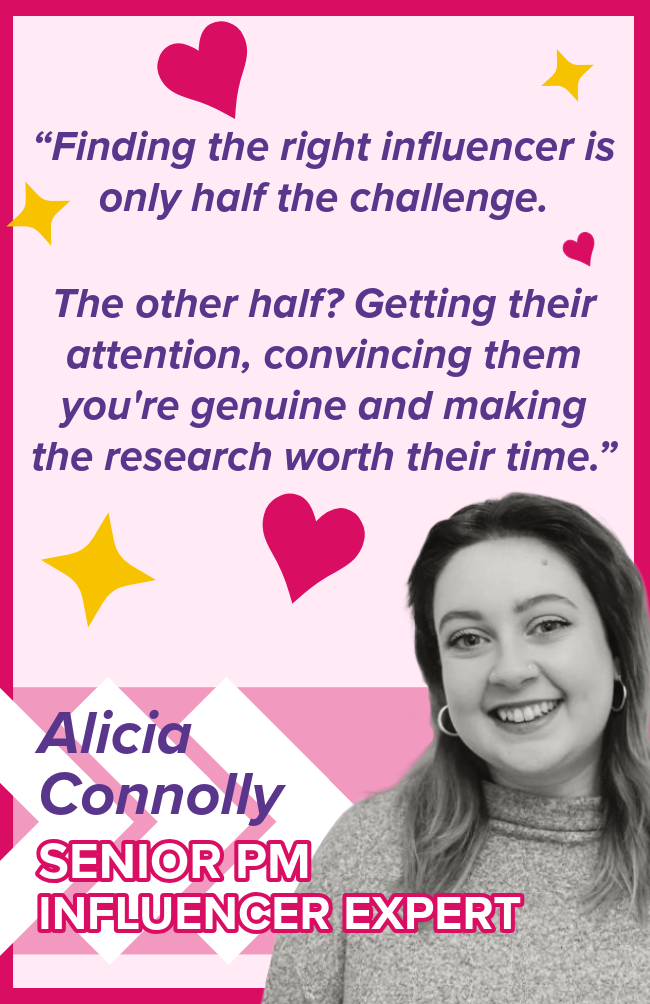
First, there’s the challenge of getting noticed. Creators receive all sorts of messages, from genuine opportunities and commercial approaches to unsolicited promotions and the occasional outright scam.
Our invitation has to stand out, establish credibility and explain why taking part in research is worth their time.
And even when we’ve found someone who looks perfect, they don’t always respond. Ghosting, as our recruitment team will readily confirm, is a familiar occupational hazard. Availability can be another surprise.
It’s easy to imagine content creators spending their days filming videos, responding to followers and enjoying wonderfully flexible working lives. In reality, many have full-time jobs alongside their online activity.
That can make scheduling a daytime interview considerably more complicated than expected, particularly when the client wants participants to attend in person. Incentive expectations also vary. The size of someone’s following, their specialist knowledge, the time commitment and any travel involved can all influence what makes participation worthwhile. It’s precisely why those early conversations between the RFQ manager and project manager matter so much.
A recruitment route that looks straightforward on paper can involve hours of searching, screening and follow-up. A creator who appears readily available might need a different interview time, a higher incentive or additional travel arrangements.
By considering those possibilities before quoting, we can build a more realistic picture of the resources involved and avoid making promises that become difficult to keep once a project is underway. Sometimes the challenge lies in the methodology itself.
One completed project involving household cleaning products required participants to attend a house in London, moving between different rooms for research activities and interviews.
It was an ambitious undertaking, with plenty to consider before anyone arrived at the venue. Recruiting suitable people was only one part of making the research work. And occasionally, we have to recognise when an enquiry isn’t really about research recruitment at all.
We were recently approached about engaging influencers to promote a recruitment campaign to their followers, with the activity measured against the performance of that promotion. It was an interesting proposition, but it belonged more naturally in the world of influencer marketing than research recruitment. So we declined.
There’s an important distinction between paying creators to promote something and inviting them to share their knowledge, experiences and perspectives as research participants. We work firmly in the latter.
TEN YEARS OF INFLUENCE
When we asked our quotation team to reflect on how influencer recruitment has changed since that first vlogger project, their answer was refreshingly straightforward.
In the early days, there was a certain amount of taking a chance. Finding someone who looked suitable, making an approach and seeing what happened. Over time, we’ve developed a much stronger understanding of how creator communities work, what different briefs require and how to engage the people we’re trying to reach.
We’ve learned how to investigate niche audiences before committing to a project, how to recognise genuine expertise, how to navigate the practicalities of creator participation and when to suggest a different approach. We’ve also learned the value of getting the right people around the table before a quotation ever reaches a client.
The partnership between the person assessing the brief and the person likely to deliver it helps us make informed decisions about recruitment routes, project resources and commercial feasibility. It means our quotations are grounded in a practical understanding of the work involved, not simply an optimistic interpretation of what’s being requested. And it gives our project managers a stronger starting point when the research is commissioned.
Along the way, we’ve also learned that social media can be a wonderfully unpredictable place.
One day you’re investigating the commercial relationships surrounding a household-name snack. Another you’re exploring how creators earn money through a particular platform. The next you’re talking to someone who has taught their cat to communicate. And somewhere along the way, you’re reminded that behind every profile is a person whose experiences may be considerably more interesting than their follower count.
That first vlogger project in 2016 wasn’t something we set out to turn into a specialist recruitment offering. It was simply another interesting brief that needed the right people finding for it. Ten years later, the platforms, terminology and communities have changed beyond recognition, but the fundamental challenge remains much the same.
Understand who the client really needs to speak to. Work out where those people might be. Establish whether they’re genuinely suitable. And find a way to bring them into the research.
It’s what we’ve been doing since the beginning, even if we didn’t realise quite how early our influencer story started.
Ten years of influence, countless fascinating people and more than a few unexpected discoveries.
Looking for influencers, content creators or specialist voices for your next research project?
Whether your brief is straightforward or a little more unusual, we’d love to hear about it.