
When a project involves food testing, tight criteria and multiple in-person sessions, every detail matters.
For this study, we led recruitment and fieldwork for a double-stage product lab with a leading UK chocolate brand. The brief called for careful screening, allergy checks, consent capture and reliable respondent attendance across both sessions.
In this kind of research, good fieldwork is not just about filling quotas. It is about protecting the quality of the insight from the very start.
THE BACKGROUND
We supported a leading UK chocolate brand with recruitment and fieldwork for a two-stage product lab in the West Midlands.
The study was designed to support new product development, giving the end client the opportunity to explore reactions to products, gather feedback and generate fresh ideas through a series of moderated in-person sessions.
At first glance, the brief appeared manageable. In reality, it involved a tightly defined audience, a fixed venue, weekday daytime attendance and a two-stage commitment over several weeks. That combination made careful planning essential from the outset.
THE BRIEF
The project required 48 participants to attend two 120-minute moderated product lab sessions at a West Midlands venue.
Participants had to meet a strict set of criteria. They needed to be the right type of chocolate consumer, available at a specific time of day, and have no allergies or braces. They also needed to be willing and able to attend two separate weekday sessions, with a two-week gap between stages.
For both the client and the end client, the risks were clear. If the sample was not right, the quality of the product feedback would be compromised. If attendance dropped between stages, the continuity of the research would suffer.
This was not simply a recruitment task. It was a fieldwork challenge where quality, commitment and operational control all had to work together.
THE APPROACH
We built the project around three priorities: accuracy, commitment and control.
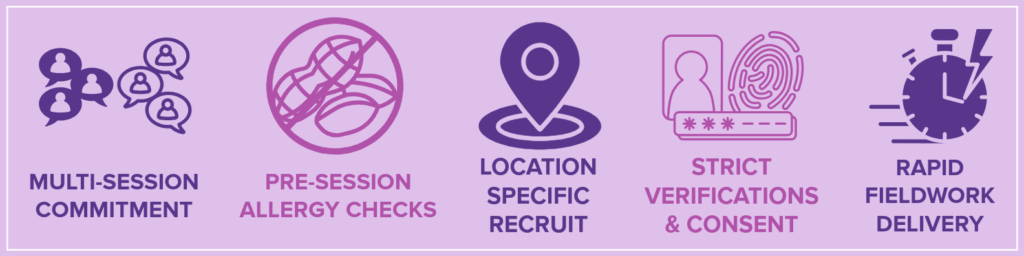
First, we made the screening process deliberately rigorous. Key qualifying questions were repeated at different stages to test consistency and reduce the risk of inaccurate claims. This was especially important in a food testing setting, where allergy screening and suitability checks were critical.
We also introduced NDA and allergy disclaimers at recruitment stage, rather than later in the process. This gave the end client written confirmation early, supported participant safety and reduced avoidable risk before anyone arrived on site.
As recruitment progressed, the brief proved more demanding than it first appeared, so we brought in local recruiters to strengthen coverage within a tighter catchment area. This was an important operational step, helping us source participants who lived closer to the venue and improving the likelihood of attendance across both stages.
We managed the project as a live attendance challenge, not a one-off booking exercise. Respondents were given both session dates from the first screening call, allowing them to commit properly from the outset. From there, we maintained close contact through reminder calls, text messages, travel guidance and clear arrival instructions.
To help maintain engagement across both stages, incentives were structured in two parts and weighted to encourage full attendance through to the final session.
Client communication remained constant throughout. We shared daily status logs and provided access to a live respondent update, giving the client real-time visibility of participant data, responses and attendance. That level of transparency helped keep everyone aligned and reduced the risk of last-minute surprises.
FIELDWORK DELIVERABLES
We delivered:
– Recruitment for 48 participants in the West Midlands
– Four moderated product lab sessions across a double-stage design
– Daily status logs throughout recruitment and fieldwork
– Secure data transfer via the agency portal
– Online respondent grid with live participant data and attendance visibility
– Signed NDA and allergy disclaimers captured at recruitment stage
– Ongoing reminder calls and texts before both stages
– Detailed maps, parking guidance, and arrival instructions for all participants
These deliverables mattered because they supported both the smooth running of the sessions and the quality of the data collected. In a sensory product test, even small operational gaps can quickly become research risks. Our role was to reduce those risks before they affected the room.
END TO END MANAGEMENT
This project required close management from the beginning. We moved quickly from briefing to live fieldwork, turning around a complex two-stage recruit at pace while maintaining control through to the final session.
Our client’s main concern was reliability. The risk of no-shows and drop-outs was high, given the weekday daytime schedule and the requirement for participants to attend twice.
For participants, the challenge was practical. Attending two separate two-hour sessions during the working day required work, home life and travel arrangements to be managed in advance. They needed clarity, confidence and regular communication to stay committed.
Quality control was the commissioning brand’s clear priority for delivery. They needed the right consumer profile, complete consent documentation and confidence that the people in the room were genuinely suitable for the task.
We managed these competing pressures through frequent contact, clear briefing and a fast response throughout delivery. When two respondents were delayed by train cancellations and limited parking, we acted quickly after receiving their calls and arranged alternative travel support. As a result, both respondents still made it to the venue in time for the session.
That kind of hands-on fieldwork management can make a real difference. It protects attendance, reassures participants and helps the client feel in control throughout the project.
SUCCESSFUL OUTCOMES
The project was delivered on time, with a fully verified sample and no discarded data points.
Every respondent completed the required disclaimer and provided online consent to take part in both sessions. All participants were recruited to spec, with no quota flexes required.
Despite the complexity of the brief, the challenging location and weekday timings, the overall outcome remained strong. There were only five no-shows across the project and, although the study finished three respondents under target, the client was happy with the quality of those who attended.
This delivered value in three important ways:
Time
The project stayed on schedule from briefing through to the final session.
Cost
Rigorous screening and active attendance management helped avoid waste caused by unsuitable recruits or unusable data.
Quality
The sample remained on spec, consent was captured early and no data points were discarded.
BEAM IN ACTION
What made the difference here was not one single tactic. It was the way the whole project worked together.
We delivered:
– Rigorous screening with practical participant care
– Improved recruitment quality and conversion using local recruiters in a difficult geography
– Second-stage commitment by structuring incentives to support attendance
– Frequent and detailed client updates
– Advanced preparation for threats to attendance, not response to or absorption of the loss
That is where we believe BEAM stands apart. We do not treat recruitment, fieldwork and project management as separate tasks. On more demanding studies, they need to operate as one joined-up delivery model.
That is especially true in product labs. Strong outcomes depend on more than attendance alone. They depend on the right people arriving informed, on time, properly screened and ready to take part.
THE RESULT
The result was a well-managed, two-stage product lab for a leading confectionery brand, delivered on time and with strong sample integrity.
The commissioning brand was able to move forward with consumer feedback from a verified, and tightly managed participant group. Participants engaged well within the sessions, and feedback was positive. Respondents described the experience as exciting and interesting, and several appreciated being invited back for the second stage to continue the discussion with people they had already met.
In practical terms, the project showed that even a demanding brief can be delivered successfully when recruitment strategy, communication and project management are aligned from the beginning.
THE LEARNING
One of the biggest learnings from this project was that early feasibility needs to go beyond audience criteria alone.
On paper, the brief was clear. In practice, the combination of location, age range, living status, consumer type and weekday daytime timings made the recruit more challenging than first expected. Bringing in local recruiters was an important adjustment and played a major role in helping us deliver successfully.
The second learning was around two-stage commitment. When participants are asked to attend more than one in-person session, timing becomes even more critical. We managed that challenge well on this project, but it reinforced an important point for future studies: where possible, session timings should be designed to reduce friction for working-age participants.
This project also confirmed the value of capturing consent and disclaimers at the earliest stage. That supported the participant experience, strengthened the end client’s duty of care and kept the fieldwork process cleaner and more efficient throughout.
Planning a product lab, sensory test, or multi stage qualitative study?
We can help you build the right sample and keep delivery on track from start to finish.
Back to Case StudiesLet BEAM Fieldwork support your research project. Fill in the contact form below
or give us a call on 0161 850 9864