
When a project involves a well-defined B2B audience but highly specific banking behaviours, the real challenge sits beneath the surface.
For this study, we led recruitment and fieldwork for a major UK financial services project exploring the needs of businesses with annual turnover between £1 million and £25 million. The brief called for owners, directors and finance managers across service led and asset heavy sectors, tightly managed quota layers, detailed screening, full verification, and genuinely engaged respondents ready to take part in 60 minute depth interviews.
THE BACKGROUND
We led recruitment and fieldwork for a complex business banking study designed to generate clear, actionable insight.
The audience was highly specific. It included owners, directors and finance managers from businesses with between 0 and 250 employees, across both service led and asset heavy industries. The sample also needed to reflect a mix of high street, challenger and multi-bank users, with hard quotas around business age, legal structure, current account capabilities, channel preferences, and growth strategy.
This was a high stakes brief. The client needed confidence that every participant was genuine, relevant, well screened, and ready to contribute meaningfully.
THE BRIEF
The aim was to understand the needs of businesses turning over between £1 million and £25 million.
More specifically, the client wanted to know:
– What is important to these businesses
– What they need from their banking relationships
– Where and how banking fits into the wider running of their business
The fieldwork involved 48 depth interviews, each lasting 60 minutes, supported by a short pre-task.
The sample was split across two audiences:
– Audience 1: 24 small businesses with annual turnover between £1 million and £6.5 million
– Audience 2: 24 medium businesses with annual turnover between £6.5 million and £25 million
Within each audience, quotas were evenly split between service led and asset heavy businesses.
THE APPROACH
From the start, we knew this study would require more than simple recruitment.
These participants were often cash rich and time poor. They needed to see the value of taking part, trust the process, and feel assured that the information they shared would remain confidential.
So we built an approach around three priorities: precision, verification, and participant care.
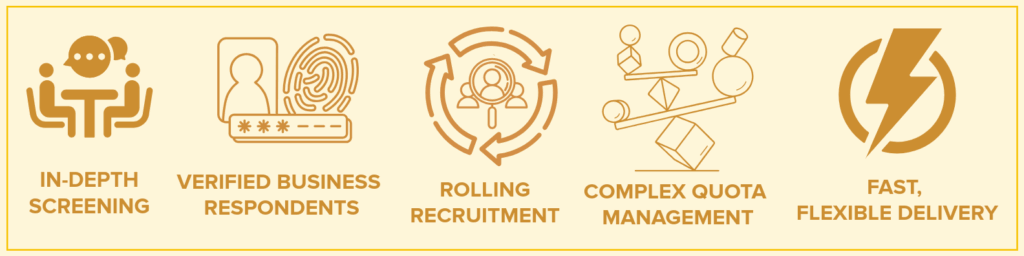
We carried out detailed screening calls to assess suitability and make sure every respondent fully understood what participation involved. We then added further verification through Companies House checks and LinkedIn cross-referencing.
This gave the client confidence in the sample and gave participants confidence in us.
We also worked with a rolling recruitment model through Lens. That helped us move quickly while still preserving the time needed for robust screening and verification.
FIELDWORK DELIVERABLES
We delivered a tightly managed fieldwork programme designed to meet a complex brief without compromising on quality. The project combined detailed recruitment, careful scheduling, and consistent client communication throughout, ensuring each stage ran smoothly from set-up to final interview.
Key deliverables included:
– 48 depth interviews, each 60 minutes long
– A short pre-task completed ahead of every session
– Two distinct turnover-based audience groups, with a balanced split of service led and asset heavy businesses
Alongside recruitment and fieldwork delivery, we also provided daily client email updates, managed moderator diaries and scheduling support, sent Outlook invites directly to moderators, and kept the end client profile grid updated throughout the project. Every participant was recruited fully to spec, and every respondent completed the pre-task and attended fieldwork.
END TO END MANAGEMENT
This project demanded close control from briefing through to delivery.
The turnaround was tight, with just 14 days from briefing to fieldwork start. At the same time, the scheduling picture changed mid-project. The original plan involved three moderators with specific timing requirements. Part way through recruitment, unforeseen circumstances reduced this to two moderators and changed availability.
That shift created immediate delivery pressure.
We responded quickly by reorganising schedules, adapting availability, and maintaining momentum without lowering recruitment standards. Alongside that, we continued to manage moderator invites, update the separate moderator diary, and maintain the end client profile grid.
Daily updates kept everyone aligned. That visibility mattered. It reduced uncertainty, supported faster decisions, and helped the client feel in control even as the plan evolved.
SUCCESSFUL OUTCOMES
The result was a smooth delivery against a demanding brief.
We achieved:
– 48 out of 48 participants recruited fully to spec
– Zero no shows
– 100% verified human sample
– 100% completion across pre-task and fieldwork activities
– On-time delivery despite moderator availability changes
For the client, this meant dependable progress against an ambitious timeline.
For the research agency, it meant quality participants who matched the brief and supported the project objectives without avoidable delays or overspend.
For participants, it meant a clear, professional experience that respected their time and built trust from first contact to interview completion.
BEAM IN ACTION
This project showed the value of combining rigorous recruitment with active fieldwork management.
Our differentiator was not just that we filled the sample. It was how we did it.
We built quality in at every stage:
– Detailed screening calls to test suitability
– Verification checks through Companies House and LinkedIn
– Rolling recruitment to protect timelines
– Day-of-session reminder calls to confirm attendance and Zoom access
– Technical reassurance and support before sessions
– Contingency respondents held on standby in case of drop out or no show
– Daily communication with the client and agency team
This is where good fieldwork makes the difference.
In practice, it reduced risk, protected interview quality, and gave the client a dependable route to insight. It also meant the moderators could focus on the conversations, knowing the operational side was tightly managed.
THE RESULT
The project delivered a strong outcome for time, cost and quality.
Time
We moved from briefing to fieldwork in 14 days.
Rolling recruitment helped us keep pace without cutting corners on screening or verification.
Cost
By recruiting accurately first time and maintaining a standby pool, we reduced the risk of costly late-stage replacements, session loss, or project delays.
Quality
We delivered a fully verified sample, recruited exactly to spec, with zero no shows.
That quality gave the client a reliable foundation for insight generation.
The feedback reflected that success. Following the first debrief, the client shared:
“We’ve had the first debrief for the project this morning and it went REALLY well, thanks again for all your work on the project!”
That response matters because it speaks to more than logistics. It shows the recruitment and fieldwork stood up in the room, where insight is judged.
THE LEARNING
One of the biggest lessons from this project came from the change in moderator availability.
Although we adapted successfully, it added pressure at a critical point in delivery. The experience reinforced the value of building more flexibility into scheduling from the outset.
For future projects of this kind, it would be beneficial to agree a small number of standby moderating dates at briefing stage. That would create more resilience, reduce risk if availability changes, and make a strong process even stronger.
It also reaffirmed something we see time and again in specialist B2B work. Good recruitment is not only about finding the right people. It is about preparing for real world change while protecting sample quality, participant experience, and client confidence.
If you need high quality B2B recruitment with rigorous verification, careful participant management, and fieldwork that stays steady under pressure, we would love to help.
At BEAM, we combine precision, flexibility and hands-on delivery to help research teams get closer to the people they need to understand.
Back to Case StudiesLet BEAM Fieldwork support your research project. Fill in the contact form below
or give us a call on 0161 850 9864