THE BACKGROUND
Utility providers need to understand customers who face barriers when engaging with services. In this project, the focus was customers with specific personal needs linked to health conditions, disabilities, cultural differences, and language barriers.
THE BRIEF
Our client wanted a deeper understanding of customers with specific needs and requirements, including:
1 | Health conditions and disabilities
2 | Cultural differences
3 | Language barriers
FIELDWORK DELIVERABLES
Recruitment of a diverse sample of billpayers with specific needs:
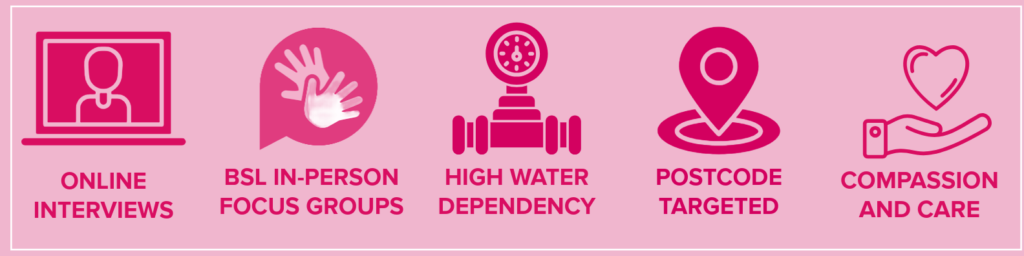
Physical disability/health conditions: requiring high use of, or high dependency on water (customer list)
Non-native speakers: requiring assistance to understand and respond effectively (free-find)
Minority religion or culture: under-represented in related studies (free-find)
Verbal/aural disability: requiring assistance due to mild to severe disability (free-find/customer list)
Verbal/aural disability: BSL speakers with profound hearing loss or deafness (customer list)
END-TO-END MANAGEMENT
We worked as one team with the client and agreed flexibilities upfront to reduce delivery risk:
Increased recruitment timings to three weeks
Online or in-person depth interviews
Budget flexibility for additional support, as requested by participants
Provision of client lists with health conditions or disabilities
We managed sourcing, screening, consent, accessibility requirements, interpreter coordination, and session logistics.
SUCCESSFUL OUTCOMES
1 | Recruitment succeeded early for mild to severe verbal/aural disabilities, minority religions, and health conditions/disabilities with high water dependency.
2 | We identified and resolved the main barriers affecting two groups: non-native speakers and people with profound or total hearing loss.
3 | The work was shortlisted for the 2024 MRS Oppies ‘Recruitment Excellence’ Award.
BEAM IN ACTION
Non-native speakers (free-find): Traditional databases, recruiter networks, and local interviewer outreach did not convert. So we shifted to desk outreach with community entry points. This connected us with family members in Hindu and Muslim communities who supported bill-paying elders to take part. Operationally, this protected data quality because participants were recruited with context, support, and clear expectations.
Profound or total hearing loss (customer list): Warm leads were provided with email-only permissions. Despite in-house efforts, this route did not deliver recruits. We then identified a core operational constraint: email is often a poor fit where written English exposure is limited.
To solve this, we partnered with a local business providing BSL and lip-speaking interpreters. With their guidance, we redesigned screening and consent:
1 | BSL-signed video questions
2 | Participant responses via WhatsApp
3 | Translation into written responses for recording purposes
Finally, we pivoted delivery to an in-person focus group at a local centre for the deaf. It included four deaf participants, two interpreters, and was led by the non-BSL-speaking client. This approach reduced participant burden and improved communication reliability.
“BEAM Fieldwork were excellent at finding solutions to connect us with the people we wanted to talk to and helped us to learn new ways of communicating with under-represented members of the public that we hadn’t considered before.”
THE RESULT
A flexible, accessibility-led approach enabled the client to speak with under-represented customers and learn new, practical ways to communicate with them in research settings (as stated in the client quote).
THE RESULT
Build accessibility into feasibility, not as a late adjustment.
Do not assume written channels will work for deaf participants, especially where literacy and language exposure vary.
Community-led recruitment can outperform “standard” routes for non-native speakers.
Interpreter partnerships are not just a session add-on, they can unlock screening, consent, and data integrity.
If you need support recruiting under-represented audiences, or designing inclusive screening and consent, CONTACT US to scope an accessibility-first approach.
READ MORE about our 2024 Oppies celebrations here
Back to Case StudiesLet BEAM Fieldwork support your research project. Fill in the contact form below
or give us a call on 0161 850 9864