
Customer closeness has become a familiar phrase in research, but the best programmes do something very specific.
They help teams stop thinking about customers as segments, targets, or data points and start seeing them as real people with routines, habits, tensions, needs, and language of their own.
That shift can be powerful.
It can sharpen brand thinking, challenge assumptions, and give internal teams the confidence to make better decisions. But for customer closeness to work, the fieldwork has to be designed carefully.
At BEAM, we see customer closeness as both a research exercise and an internal learning experience.
START WITH THE TRUTH
The first question is simple: are we putting the right people in front of the client?
If the answer is uncertain, the whole programme is at risk.
In our customer closeness work with a global branded food manufacturer, the client wanted sales and marketing colleagues to understand Growth Target customers ahead of the next trading and marketing calendar year. Each colleague pair completed one consumer interview, creating an immersive experience around brand growth and development.
The value of the programme depended on recruitment truth. Participants had to genuinely match the Growth Target, buy and consume the relevant products, and feel comfortable with the methodology.
To protect that, we used a gated recruitment process with clear pass criteria. We verified location, methodology agreement, screening fit, past participation, ID, proof of purchase, product consumption, live screen checks, and written consent.
This gave the client confidence that the people they were meeting were the people they needed to understand.

MAKE IT IMMERSIVE
Customer closeness is strongest when it gets close to real life.
In-home interviews helped the client see context, not just hear opinions. Kitchen cupboard photography, product discussion, and note-taking brought shopping and consumption behaviours into view. Participants could talk naturally about what they bought, where they kept it, how they used it, and why it mattered.
That kind of detail can be difficult to recreate in a traditional setting.
At the same time, we knew the programme had to stay inclusive and on schedule. Where geography made in-person attendance impractical, online interviews gave the client a controlled alternative. The format changed, but the standards remained consistent.
This is an important point for customer closeness. Immersion does not have to mean inflexibility. The right blend can protect momentum without losing quality.
SUPPORT THE CLIENT
Customer closeness often asks client employees to take on a role they do not usually play.
They may be brilliant marketers, brand leads, sales specialists, or product experts, but that does not mean they are trained interviewers. Without support, there is a risk of leading questions, missed opportunities, awkward introductions, or inconsistent conversations.
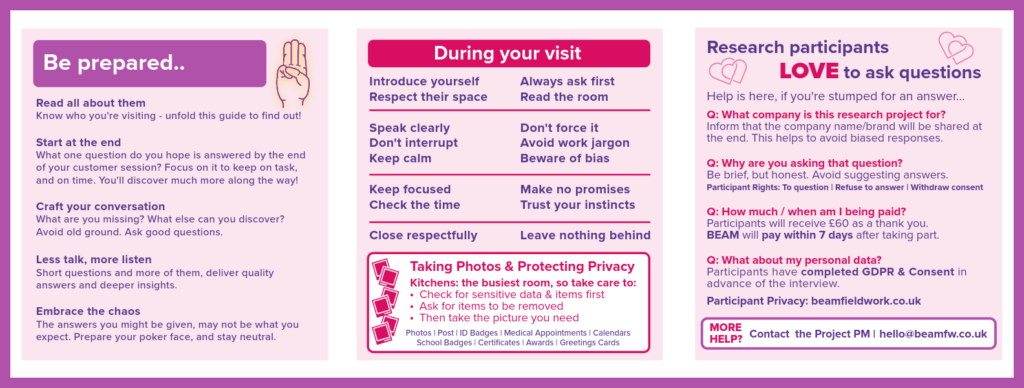
We built in an interviewer initiation to help client colleagues prepare. It covered arrival protocol, introductions, interview etiquette, discussion techniques, bias awareness, reassurance, and how to close the session.
This gave teams enough structure to feel confident, while still allowing the conversations to feel natural.
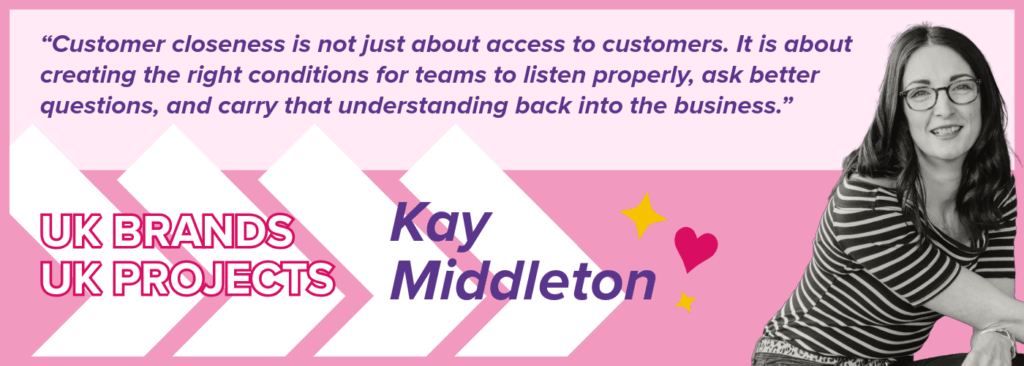
As Kay Middleton, Director of Operations and brand specialist shares:
HELP PEOPLE CONNECT
A good customer closeness session is human.
That means rapport matters. Language matters. Preparation matters.
For this programme, we created a Participant-on-a-Page profile for each client pair. The aim was to provide a quick, useful snapshot of the person they were about to meet. It helped reduce nerves and gave the client team a way into the conversation.
It also kept the discussion grounded in the participant’s own language. Texture cues, benefit cues, ingredient cues, and pack format references gave client teams a more natural way to explore behaviour.
Small details like this can make a big difference. They help move the session away from a formal interview and towards a more open, meaningful conversation.
PROTECT THE EXPERIENCE
In-home customer closeness asks a lot of participants.
They may be hosting two client colleagues, allowing access to cupboards and appliances, discussing personal routines, and agreeing to image or video capture. That requires careful expectation setting.
We scoped the requirements with the client, then captured agreement repeatedly through written and verbal touchpoints. Participants knew what was being asked, why it mattered, and how their information would be handled.
We also managed personal data carefully, using secure digital access, password protection, two-factor authentication, QR code access, and timed session time-outs. Participants were guided to review their space and remove anything sensitive before capture.
This level of care protects the participant experience and the client’s confidence.
FROM MOMENT TO MOMENTUM
The strongest customer closeness programmes do not end when the interview does.
They create internal momentum. They give teams stories, language, and real-world context they can carry into planning, brand development, innovation, and communication.
In this project, the client gained direct exposure to Growth Target customers through a mix of in-home and online interviews. The programme helped sharpen brand and competitor understanding, while keeping recruitment quality, schedule certainty, participant care, and data security at the centre.
Following delivery, the client requested follow-on sessions and further research with selected participants who strongly reflected the Growth Target.
That is what customer closeness should do. It should open the door to deeper understanding, not tick a box.
THE BEAM VIEW
Customer closeness is not just a methodology. It is a moment of connection between a business and the people it serves.
Our role is to make that connection useful, safe, structured, and human.
That means finding the right participants, preparing the client team, protecting the participant experience, and creating a process that gives insight the best chance to land.
Because when teams meet real people in the right way, they do not just hear what customers think.
They understand why it matters.
Let’s talk…
If you are building a customer closeness programme and need fieldwork that balances immersion, structure, and participant care, we would LOVE TO HELP