
Fast-turnaround research can be brilliant. It creates momentum, helps teams make decisions while the questions are still live, and gets insight into stakeholders’ hands when it can genuinely change outcomes.
The difference between a fast project that feels energising and one that feels frantic usually comes down to a few controllable factors. Here’s how we think about setting fast-turnaround fieldwork up for success, without compromising on data quality or participant experience.
Start with a clear definition of “fast”
“Fast” means different things to different teams. Before anything else, align on what success looks like in practical terms:
- Clear participant definitions (who is in and who is out)
- Prioritised quotas (must-haves vs nice-to-haves)
- A short, decision-ready screener that avoids ambiguity
- Practical feasibility checks early (incidence, geography, device access, gatekeepers)
If something is likely to be niche, we would rather know on day 1 than discover it mid-recruit.
Make recruitment frictionless for participants
When timelines are tight, every point of friction increases drop-off. The best fast projects tend to:
- Use simple, mobile-friendly scheduling
- Keep comms clear and human
- Confirm key details early (availability, tech checks, consent)
- Offer appropriate incentives that match the ask and reduce last-minute withdrawals
It is not about rushing participants. It is about making it easy for the right people to take part.
Protect data integrity with smart verification
Speed should never mean “take whoever we can get”. In fast-turnaround work, verification becomes even more valuable because there is less time to recover if something slips through.
Practical safeguards include:
- Consistency checks across screener and follow-up calls
- Identity and eligibility verification proportionate to risk
- Fraud pattern monitoring in digital recruit environments
- Reserve bench planning for key quotas
A little structure upfront prevents the biggest delays later.
Plan for attendance like it matters (because it does)
Fast timelines leave less room for no-shows. The projects that run smoothly usually include:
- Over-recruit where it is sensible
- A reserve bench ready to step in
- Reminder cadence that is timely, not spammy
- Clear joining instructions and tech support where needed
Attendance is not just logistics. It is how you protect the schedule and the learning plan.
Keep stakeholders aligned with a simple cadence
Fast projects succeed when everyone can see what is happening in real time. A light-touch but consistent rhythm helps:
- Daily (or agreed) recruitment progress updates
- Early flags on any quota pressure
- Confirmed session logistics shared in one place
- Clear ownership on sign-offs (screener, guide, stimulus, outputs)
This reduces last-minute changes, which are usually the true enemy of speed.
Choose the “fast” method that still answers the question
Sometimes the quickest route is not the shortest session. The fastest route is the method that generates usable learning without rework.
Good fast-turnaround options can include:
- Online depth interviews (IDIs)
- Shorter, focused sessions with crisp objectives
- Hybrid approaches (a small number of deeper conversations plus a wider, lighter-touch qual add-on)
The goal is not to do less. It is to do what is most decision-useful.
Treat participant care as a delivery lever
Participant experience is not an extra. In fast timelines, it is a reliability tool.
Clear expectations, respectful comms, accessibility considerations, and safeguarding where relevant all contribute to better show rates and better quality conversations.
The takeaway
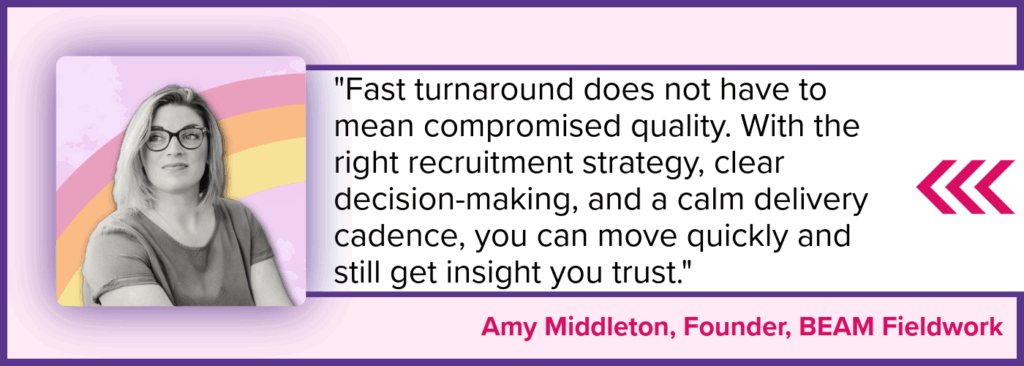
Fast-turnaround projects work best when speed is designed in, not chased at the end. With a tight brief, realistic quotas, robust verification, and a steady communication cadence, you can move quickly and still feel in control.
Got a fast-turnaround project on the horizon?
Send us your timeline, target participants, and markets, and we will sense-check feasibility and map the quickest route to high-quality fieldwork. Email hello@beamfieldwork.co.uk or use our CONTACT FORM to get started.