
Global fieldwork is rarely difficult because of one big problem. It becomes difficult because of lots of small moving parts.
Different markets. Different suppliers. Different time zones. Different venue requirements. Different participant expectations. Different client teams, all needing timely answers.
When those moving parts are not held together by one clear point of contact, complexity can quickly become noise.
At BEAM, we believe international fieldwork works best when communication feels calm, connected, and accountable. That does not happen by accident. It happens when every person involved knows where information sits, who is making decisions, and who is keeping the full picture in view.
ONE JOINED UP VIEW
International research often involves several teams working at once.
There may be a client agency in one country, an end client in another, local recruitment partners, translators, moderators, venues, observers, travel providers, and participants across multiple markets. Each group needs information, but they do not all need the same information at the same time.
Without one clear point of contact, the project can start to fragment.
A venue receives one version of the brief. A recruiter receives another. A moderator is waiting for updated stimulus. The client wants a progress update, but no one is fully sure which market has changed, which participants are confirmed, and which risks are still live.
The problem is not that people are not working hard. It is that no one has a single joined-up view.
A central point of contact protects that view. They hold the project story from briefing to fieldwork, making sure every decision is understood in context.
FASTER DECISIONS
International projects often need quick decisions.
A participant drops out. A market needs more recruitment time. A venue changes access requirements. A client observer has a travel question. A local partner flags that one screening question does not translate clearly in market.
If every decision has to travel through several people before it reaches the right person, time is lost. Worse, decisions can be made without the right context.
One point of contact helps decisions move quickly and sensibly. They understand the client’s priorities, the project constraints, the budget, the methodology, and the market realities. They know what can flex and what needs to stay fixed.
That judgement matters.
Global fieldwork does not need rushed decisions. It needs informed decisions made at the right speed.
CONSISTENCY ACROSS MARKETS
One of the biggest challenges in international fieldwork is protecting consistency.
Consistency does not always mean every market works in exactly the same way. It means every market is working to the same research standard, with the same clarity around audience, method, timings, quality checks, and outputs.
A central contact helps protect that consistency.
They make sure local teams understand not only what needs to happen, but why it matters. They track where adaptations are needed and make sure those adaptations are agreed rather than accidental. They keep screening, recruitment updates, participant communication, consent processes, and reporting aligned across the project.
In our cross-market luxury fashion work, for example, recruitment had to feel appropriate to a premium audience while still meeting robust verification standards. In our international customer closeness work, the format flexed between in-home and online interviews where geography required it, but the quality line remained the same. That balance is much easier to maintain when one person is holding the centre.
FEWER DUPLICATED QUESTIONS
Clients do not want to answer the same question five times.
Moderators do not want to chase three people for one update. Recruitment teams do not want unclear feedback. Participants should never feel the impact of internal confusion.
When there is one clear contact, information can be gathered once, clarified properly, and shared appropriately.
This reduces duplication and protects everyone’s time. It also lowers the risk of conflicting answers.
Good communication is not about sending more emails. It is about making sure the right people receive the right information at the right moment.
BETTER RISK MANAGEMENT
International fieldwork always carries risk.
That does not mean it should feel risky. It means the risks need to be visible, understood, and actively managed.
A clear point of contact is essential here. They can see patterns that individual teams may miss. One market is slightly behind on recruitment. Another is seeing higher drop-off from a specific audience. A venue detail has changed. A translator needs earlier access to stimulus. A client travel plan creates a scheduling pressure.
Individually, each issue may be manageable. Together, they may affect the wider project.
One central contact can connect those dots early and make sure the right action is taken before small issues become bigger problems.
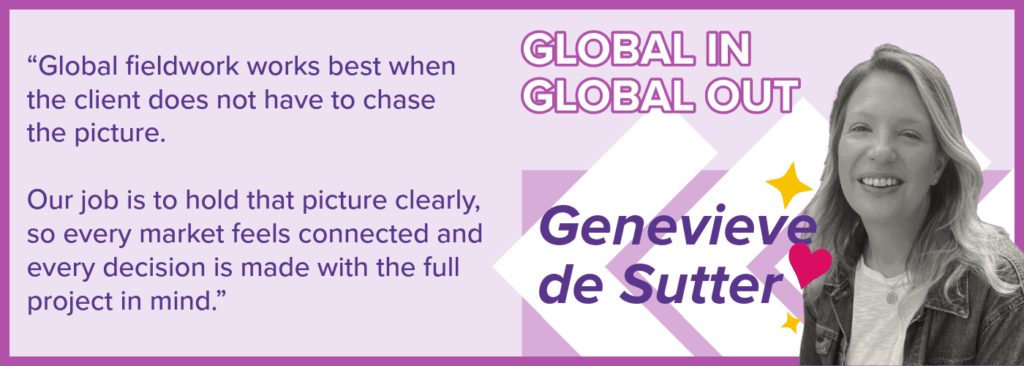
As Genevieve de Sutter, Director of International Fieldwork, says:
MORE HUMAN DELIVERY
Strong project management is often talked about in operational terms, but there is a very human side to it.
Participants need clear communication. Local partners need respect and guidance. Clients need reassurance. Moderators need practical support. Internal teams need to feel confident raising challenges early.
When communication is scattered, people can feel uncertain. When communication is clear, people can focus on doing their best work.
This was especially important in our donor insights project, where a Germany-based agency commissioned UK fieldwork on a sensitive charity topic. The end client was travelling to observe sessions in person, participants needed careful support, and the project carried emotional weight. Clear communication helped protect both the participant experience and the client’s confidence.
That is what a strong point of contact should do. Not just manage tasks, but create calm.
Read our CHARITY RESEARCH CASE STUDY here.
THE BEAM VIEW
Global fieldwork needs structure, but it also needs trust.
One clear point of contact gives clients confidence that someone is watching the whole project, not just one piece of it. It gives local teams direction. It helps moderators prepare. It supports participants. It keeps decisions moving and standards aligned.
Most importantly, it means complexity does not have to become confusion.
At BEAM, we see our role as the steady centre of the project. We connect the people, the markets, the details, and the decisions, so international research can feel ambitious without feeling chaotic.
Because when there is one clear point of contact, everyone knows where to turn, and the fieldwork has the best chance to run smoothly.
Let’s talk…
If you are planning international qualitative fieldwork and need a team to manage the detail with clarity and care, we would be happy to help. DROP US A LINE…