
There is often a moment when a research brief starts to grow.
A question that began in one market becomes relevant in three. A brand team wants comparison across territories. A product team needs to understand cultural differences. A client wants to test an idea internationally before taking the next step.
That ambition is exciting. But before a project moves from one market to many, the brief needs to be ready.
International fieldwork can create brilliant insight when the foundations are strong. When they are not, small gaps in the brief can become expensive, time-consuming, and difficult to fix once recruitment is live.
At BEAM, we help clients stress-test international briefs before they enter fieldwork, so the project has the best chance to run smoothly across every market.

IS THE OBJECTIVE CLEAR?
The first question is not where you want to field. It is what you need to learn.
International research can serve different purposes. You may want to compare markets, explore cultural differences, understand local behaviours, test a concept across territories, support internal planning, or build customer closeness in several countries.
Each purpose requires a slightly different approach.
If comparison is the goal, the sample and method need enough consistency to support that comparison. If local understanding is the goal, the design may need more flexibility. If internal immersion is the goal, client involvement, preparation, and participant experience become especially important.
A brief is ready when the objective is specific enough to guide decisions.
RIGHT MARKETS SELECTED?
Markets are sometimes chosen because they are commercially important – that makes sense. But fieldwork readiness also depends on practical and research considerations.
Is the audience available in each market? Are the behaviours comparable? Are there local regulations or cultural expectations to consider? Does the methodology make sense everywhere? Are timelines realistic across public holidays, travel, translation, and recruitment needs?
A market can be strategically important and still require a different fieldwork plan.
In our international customer closeness programme, for example, in-home interviews created valuable context where they were practical. Where geography made in-person attendance less workable, online sessions offered a sensible alternative while keeping the project moving.
The best market plans are ambitious, but grounded.
IS THE AUDIENCE DEFINED?
A brief is not ready for international recruitment until the audience is clearly defined.
This means more than demographics.
It means understanding behaviour, category involvement, purchase history, role in decision-making, usage frequency, location, attitude, exclusions, and what evidence may be needed. It also means checking whether the same audience exists in the same way across all markets.
A job title may not translate neatly. A shopping behaviour may differ by country. A product category may be structured differently. A premium customer in one market may not look exactly like a premium customer in another.
These details need discussion before recruitment begins.
Clear audience definition protects sample quality and makes the final insight more meaningful.
IS THE METHOD REALISTIC?
Some methodologies travel easily. Others need more care.
Online interviews, for example, can work well across markets when technology access is strong and the topic suits the format. In-home interviews require more participant trust, travel planning, and local support. Car clinics, fly-ins, or product-led research need detailed logistics, confidentiality planning, and often more time.
The question is not simply whether a method can be delivered.
The better question is whether it can be delivered well in each market.
In our Hamburg automotive fly-in project, the method asked a lot of participants. They had to travel internationally, follow a two-day itinerary, engage with the research, and spend time as part of a group. That meant recruitment, briefing, documentation, travel, accommodation, risk assessment, and participant care all had to be built into the fieldwork plan.
A brief is ready when the method has been tested against the reality of delivery.
Read our GERMANY VEHCILE FLY-IN CASE STUDY here.
ARE THE TIMINGS HONEST?
International fieldwork needs time for more than recruitment.
There may be translation, local review, market feasibility, screener adaptation, client sign-off, venue booking, moderator briefing, participant verification, travel planning, stimulus preparation, consent documentation, and incentive setup.
Compressing the timeline can increase risk.
Sometimes speed is possible, especially when the audience is accessible and the method is straightforward. But for niche audiences, sensitive topics, senior professionals, luxury consumers, automotive participants, or multi-market coordination, time is a quality control tool.
A ready brief has a timeline that reflects the real work involved.
IS THE BUDGET ALIGNED?
International budgets need to reflect market variation.
Recruitment costs, incentives, venues, travel, translation, moderation, local management, and participant support can vary significantly between countries. A flat budget across all markets may look tidy, but it is not always realistic.
Budget should also reflect complexity. A project that requires proof of purchase, live screening, in-home visits, photography, client attendance, or travel-based fieldwork will naturally need more management than a straightforward online interview project.
A brief is ready when the budget matches the ambition.
That does not mean spending more than necessary. It means investing properly in the parts of the project that protect quality.
ARE APPROVALS CLEAR?
International fieldwork can slow down when approvals are unclear.
Who signs off the screener? Who approves translated materials? Who decides if a participant is acceptable? Who can agree a market adaptation? Who approves incentive changes, venue changes, or revised timings?
If these questions are unanswered, the project may lose momentum once live.
One clear approval structure helps international fieldwork move smoothly. It gives the fieldwork team the confidence to act quickly, while keeping the client fully informed.
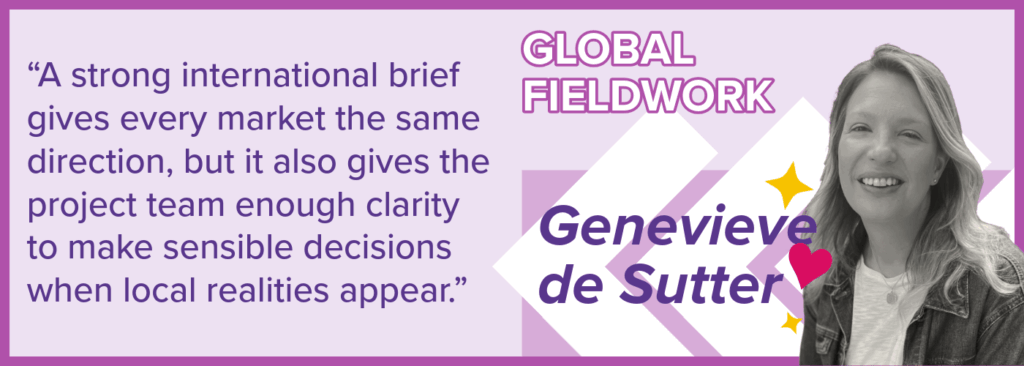
As Genevieve de Sutter, Director of International Fieldwork, says:
THE BEAM VIEW
A brief is ready for international fieldwork when it is clear enough to protect consistency and flexible enough to respect local markets.
It should define the objective, markets, audience, method, timeline, budget, approvals, quality checks, and participant expectations. It should also leave room for honest feasibility thinking.
At BEAM, we help clients turn international ambition into workable fieldwork. We ask practical questions early, because the answers shape everything that follows.
That early thinking protects recruitment, participant care, client confidence, and the quality of the insight.
Because global research works best when the brief is ready before the fieldwork begins.
Let’s talk…
If you are considering international research and want to check whether your brief is fieldwork-ready, we can help you shape the right approach from the start. Send us a message