
Automotive research has a particular energy.
It often involves high-consideration decisions, strong personal preferences, detailed product experience, and participants who need to be genuinely knowledgeable. It can involve clinics, test environments, fleet audiences, business drivers, premium customers, or travel-heavy methodologies.
It also leaves very little room for vague planning.
At BEAM, our automotive work has reinforced something we believe across all fieldwork: the quality of the insight depends on the quality of the preparation.
PRECISION MATTERS
Automotive participants are not always easy to find, and finding them is only the first step.
The research may require proof of ownership or usage, company car status, fleet decision-making responsibility, category knowledge, interest in a specific feature, or willingness to attend a detailed session. When the methodology involves travel or product exposure, the level of commitment increases again.
In our automotive fly-in project to Hamburg, we took UK company car owners, fleet managers, and key account managers to Germany for a two-day research event. The group was introduced to a car with a specific audio system.
The brief required robust recruitment, but also careful judgement. Once the group had travelled, there was no easy way to replace someone who did not fit the project or could not contribute properly. We needed participants who were verified, engaged, reliable, and suited to the event format.
That level of precision is essential in automotive research.
VERIFICATION PROTECTS INSIGHTS
In automotive fieldwork, claimed behaviour is not enough.
We need confidence that people own, drive, manage, influence, or understand the vehicles and decisions being discussed. That may include vehicle ownership checks, ID verification, background checks, proof of role, or additional screening conversations.
This is not about adding process for the sake of it. It is about protecting the insight.
A participant who only partly fits the brief can change the quality of the discussion. In a standard interview, that is a problem. In a clinic or travel-based event, it can affect the whole project.
Verification gives clients the confidence that the people in the room have the right experience to comment meaningfully.
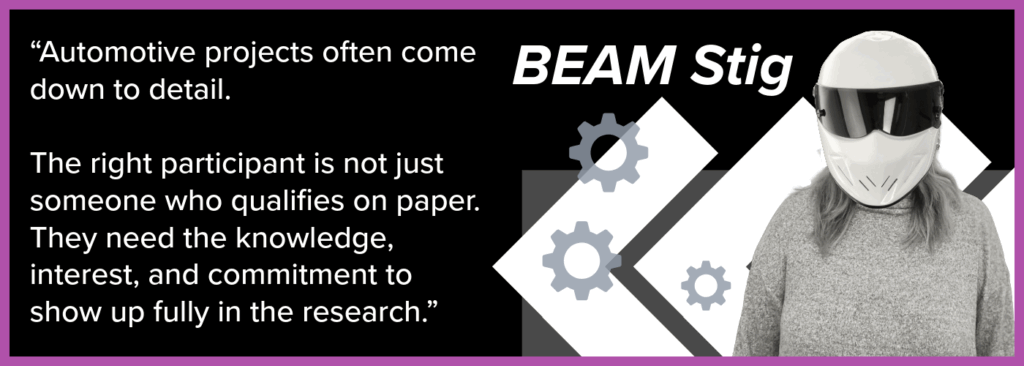
As BEAM’s Stig, says:
Read our AUTOMOTIVE AT SCALE CASE STUDY here.
LOGISTICS SHAPE EXPERIENCE
Automotive fieldwork often includes more moving parts than a standard qualitative project.
There may be vehicles, venues, display conditions, timed sessions, confidentiality requirements, travel plans, insurance considerations, client observers, specialist moderators, or international coordination. Each part needs attention.
For the Hamburg fly-in, we managed travel-essential details, dietary and health requirements, medical emergency contacts, risk assessment information, accommodation, schedules, sustenance, entertainment, and expenses. An experienced team leader accompanied the group, supporting travel, accommodation, entertainment, and group dynamics.
This kind of coordination matters because participants need to arrive ready to focus. If they are unsure where to be, what is happening next, or who to speak to, that uncertainty can follow them into the research.
Good logistics create space for better thinking.
GROUP DYNAMICS COUNT
Automotive clinics and fly-ins can involve participants spending time together outside the formal research setting. That makes group dynamics important.
It is not enough to recruit people who match the criteria individually. We also need to consider how the group will function as a whole.
Will people be comfortable travelling together? Are they likely to engage constructively? Do they share enough common ground to make the experience positive? Are there personality traits that could make the group harder to manage?
These are fieldwork questions as much as recruitment questions.
For the Hamburg project, we looked at participant suitability beyond the screener. We assessed commitment, ability to align with the itinerary, ease of providing documentation, and suitability for the research methodology. That helped protect the experience for everyone involved.
Read our AUTOMOTIVE INSIGHT IN GERMANY CASE STUDY here.
AUTOMOTIVE NEEDS EMPATHY
It can be tempting to think of automotive research as primarily technical. Vehicles, features, specifications, usage patterns, and purchase behaviour all matter.
But the human side matters just as much.
Cars can be practical, emotional, aspirational, or status-driven. Company vehicles can be tied to identity, convenience, work patterns, family needs, and business pressures. Fleet decisions can involve cost, trust, brand perception, driver satisfaction, and long-term reliability.
The best automotive fieldwork makes room for both the technical and the human.
That starts in recruitment, where we listen for genuine interest and experience. It continues in briefing, where we make sure participants understand the task. It carries through logistics, where we look after the practical details so people can contribute properly.
CLINICS NEED CONTROL
Car clinics and product-led automotive events rely on controlled delivery.
Participants need to move through the experience in the right way. Stimulus exposure needs to be consistent. Confidentiality needs to be protected. Schedules need to hold. Clients need visibility. Moderators need the right conditions. Venues need to support both the participant journey and the research requirements.
This is where fieldwork becomes operationally intense.
The visible output might be a set of interviews, groups, or evaluations. Behind that sits a much larger structure of recruitment, verification, scheduling, briefing, venue management, participant management, incentive handling, observer coordination, and contingency planning.
When that structure is strong, the project feels smooth. When it is weak, the research has to fight against the delivery.
THE BEAM VIEW
Automotive fieldwork rewards preparation.
It needs people who can think through detail, anticipate risk, communicate clearly, and keep participants engaged. It needs a balance of rigour and warmth. It needs the confidence to challenge a recruit that looks right on paper but does not feel right for the method.
Most of all, it needs respect for the fact that every moving part affects the insight.
From a weekend fly-in to a complex clinic, automotive fieldwork is never just about getting people into a room. It is about making sure the right people arrive prepared, supported, verified, and ready to contribute.
That is where the real value begins.
LET’S TALK…
If you are planning automotive research and need fieldwork support across recruitment, verification, clinics, travel, or international delivery, WE CAN HELP keep the project moving in the right direction.