
Scaling research can be a brilliant next step.
A project that begins in one market may reveal questions worth exploring elsewhere. A brand team may need comparison across territories. A product or service may be expanding internationally. A client may want to understand whether an insight holds true beyond one context.
Moving from one market to many can add real value. It can also add risk.
More markets mean more people, more decisions, more suppliers, more schedules, more interpretation, and more opportunities for drift. Without the right structure, a multi-market qualitative project can lose the very thing that made the original research useful: closeness, clarity, and control.
At BEAM, we help clients scale qualitative research carefully, so ambition does not come at the cost of quality.
KEEP THE CORE CLEAR
Before scaling, it is important to identify what must remain consistent.
This might include the research objective, participant criteria, discussion areas, stimulus exposure, session length, consent requirements, recording approach, reporting format, or quality checks.
Not everything needs to be identical across markets, but the core must be clear.
If one market is exploring a concept with highly engaged users and another is speaking to light users, the final insight may be difficult to compare. If one market uses in-home interviews and another uses online sessions, that may be perfectly valid, but the implications need to be understood.
Scaling works best when everyone knows what is fixed, what can flex, and why.
CHECK FEASIBILITY EARLY
A project that works well in one market will not necessarily work the same way elsewhere.
What is straightforward in one country can become much more challenging in another.
An audience that is easy to reach in the UK may be difficult to identify elsewhere. A behaviour that is common in one market may be niche in another. Premium consumers may respond to different recruitment channels, and a methodology that works well in one city may be impractical in another.
That’s why it pays to ask local questions before finalising the research design.
- Can we reach the audience?
- How long will recruitment take?
- What incentive is appropriate?
- Will the methodology work?
- Are there cultural or practical barriers?
- What verification is possible?
The answers may not change the ambition of the project, but they can help ensure it scales efficiently, realistically and with fewer surprises.
ADAPT WITH PURPOSE
Global research often needs adaptation. The danger is not adaptation itself. The danger is undocumented or inconsistent adaptation.
For example, online interviews may replace in-home sessions in a market where travel distance makes in-person attendance impractical. A screening question may need rewording so it makes sense locally. A venue approach may change because participant expectations differ. An incentive may be adjusted to reflect local norms.
These changes can protect quality when they are made deliberately.
In our customer closeness programme, a flexible approach allowed the client to meet Growth Target customers through both in-home and online methods. The format flexed where needed, but recruitment rigour, participant preparation, and client support remained central.
Adaptation should always serve the research objective, not convenience alone.
Read our CUSTOMER CLOSENESS CASE STUDY here.
CREATE ONE RHYTHM
Multi-market projects need a shared rhythm.
This includes briefing, recruitment updates, issue escalation, participant approval, stimulus sign-off, fieldwork-day communication, and post-fieldwork closeout.
Without a shared rhythm, markets can begin to move independently. That may feel efficient at first, but it makes the project harder to manage. Updates become inconsistent. Risks are harder to compare. Decisions are made without visibility of the wider study.
A central project lead helps keep every market connected.
They can see where one market is ahead, where another needs support, and where a decision in one place may affect the wider project. They also give the client one clear route for updates, questions, and decisions.
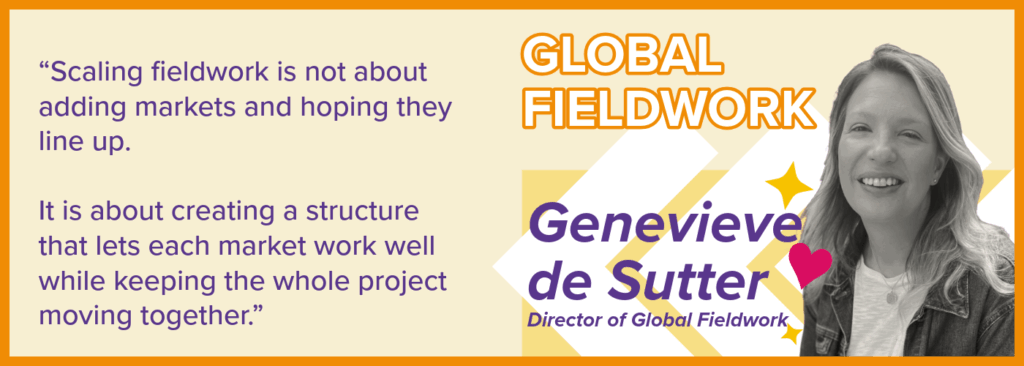
As Genevieve de Sutter, Director of International Fieldwork, says:
PROTECT PARTICIPANT QUALITY
Scaling should never mean lowering recruitment standards.
When timelines are tight and markets are multiple, there can be pressure to accept participants who are close enough. That is where quality can start to slip.
Strong screening and verification matter even more when a project scales. Proof of purchase, ID checks, live screening, role validation, or usage evidence may be needed depending on the audience. Participant fit should include eligibility, comfort with the method, communication quality, and reliability.
In our luxury cross-market work, premium audiences required careful validation and discreet engagement. In our automotive fly-in, participants had to be verified, travel-ready, and suited to the group experience. In our donor insights project, sensitive-topic recruitment required empathy, authenticity, and regular communication.
Different briefs need different checks, but the principle is the same. The right participants make scaled research meaningful.

Read our LUXURY FASHION CASE STUDY here.
SUPPORT CLIENT INVOLVEMENT
Scaling research often increases the number of client stakeholders.
Local teams may want to observe their own market. Global teams may want consistency. Senior stakeholders may need summaries. Marketing, innovation, sales, and insight teams may all have different priorities. This needs careful management.
Before fieldwork begins, it is useful to agree who will attend, how they will observe, what they will receive, and how feedback will be captured. If client colleagues are interviewing participants directly, as in customer closeness work, they need preparation and support.
Client involvement can add huge value, but only when it is structured.
KEEP THE HUMAN FEEL
One risk of scaling is that qualitative research starts to feel too operational.
Grids, markets, quotas, schedules, and updates are all necessary, but they should not overshadow the human purpose of the work.
Participants still need to feel seen and respected. Moderators still need space to explore. Clients still need to connect with real experience. Local nuance still matters.
At BEAM, we believe scaled qualitative research should remain human in every market. That means thoughtful communication, realistic scheduling, clear consent, appropriate incentives, and participant care that reflects the method and topic.
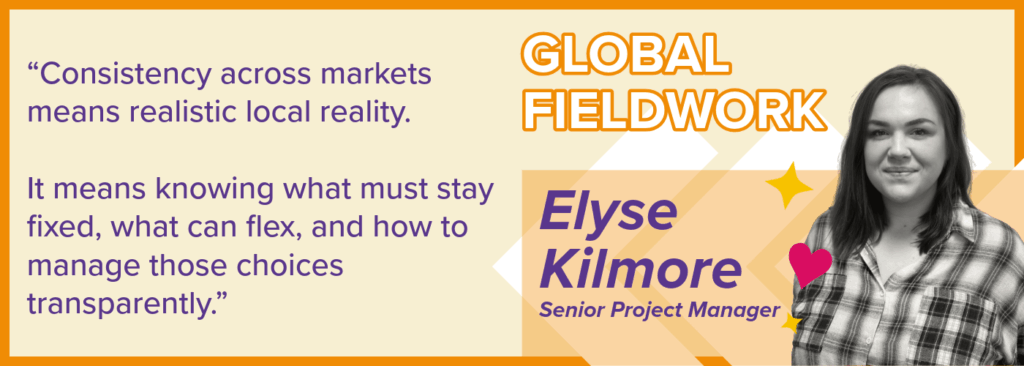
As Elyse Kilmore, Senior Project Manager, says:
KNOW WHEN TO PAUSE
Scaling well sometimes means slowing down for a moment.
If recruitment is not delivering the right people, if a market is interpreting the audience differently, if stimulus is unclear, or if a method is not working locally, pausing can protect the project.
This does not mean losing momentum. It means avoiding bigger issues later.
A strong fieldwork partner will tell you when a pause, reset, or adjustment is needed. They will also bring a recommendation, not just a problem.
Control is not about forcing the plan through at all costs. It is about knowing how to steer.
THE BEAM VIEW
Scaling global research is about balance.
You need enough consistency to compare markets, enough flexibility to respect local realities, and enough structure to keep the whole project moving with confidence.
At BEAM, we help clients move from one market to many without losing the care, rigour, and closeness that make qualitative research valuable.
We hold the detail, connect the teams, manage the risks, and keep participants at the centre.
Because when qualitative research scales well, it does not become less human.
It becomes more useful.
Let’s talk…
If you are ready to take a qualitative project from one market to many, we can help you scale with clarity, control, and care. GET IN TOUCH