
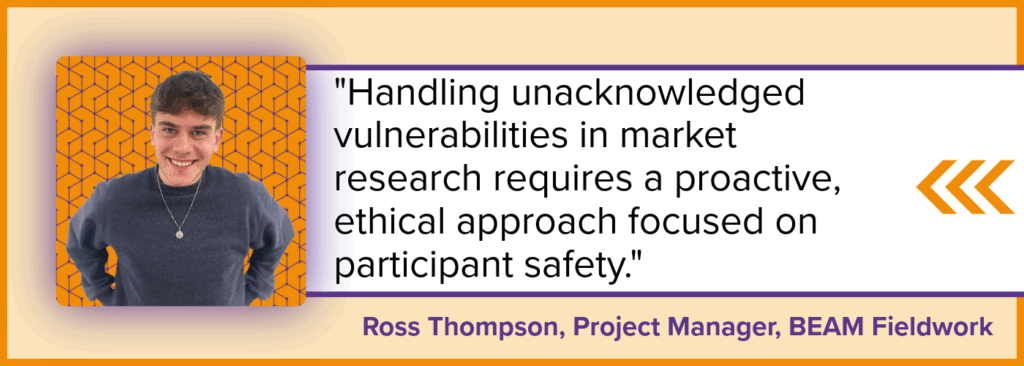
“Great recruiters sense and detect vulnerabilities and create safety throughout the recruitment process.” That is how Ross Thompson, Project Manager at BEAM Fieldwork, sums up something we see every day in real projects.
Vulnerability rarely shows up with a neat label. It can be temporary, situational, or long-term. And in market research, it can affect how we recruit, how we communicate, how we run sessions, and what support people may need before, during, or after taking part.
At BEAM, we treat vulnerability as something to plan for, not something to react to. Because participants may be unaware of their own vulnerabilities, or may not disclose them, robust protocols are essential to identify risk and manage potential distress safely.
Vulnerability is a spectrum
A practical way to think about vulnerability is as a spectrum across 4 key risk areas:
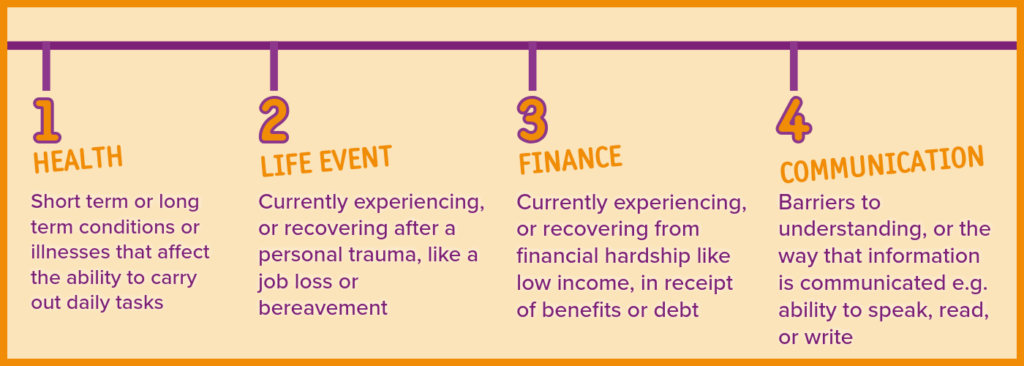
These areas can overlap. A participant might be coping well in one part of life and struggling in another. That is exactly why “one-size-fits-all” fieldwork processes can fall short.
The scale of the issue
This is not a niche consideration. The Financial Conduct Authority (2024) suggests:
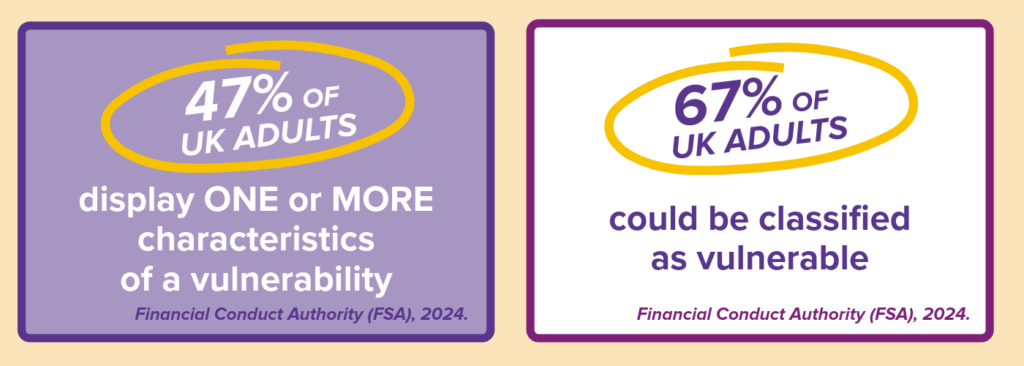
In other words, many projects will include participants who are uniquely susceptible to harm, distress, or triggers. Even if the topic itself does not seem “sensitive” at first glance.
Look beyond the screener
Screeners matter, but the real work is designing a participant journey that makes it easier to understand what is being asked, easier to opt out, and easier to access support if needed.
Here are the principles we come back to again and again.
Make consent genuinely easy
Informed consent only works if it is understood.
We simplify verbal and written consent in ways participants can clearly follow, and we treat every communication as an opportunity to check in. Practical details help too, like ensuring completed consents are instantly accessible for the participant and the project team, so nobody is searching for paperwork at a stressful moment.
Keep pressure out of process
Participants should never feel locked in.
Consent can be withdrawn at any stage, and active monitoring during the process helps ensure comfort and confidence stay intact. From a delivery perspective, this is also where strong project planning matters. Clear guardrails and realistic timelines protect participants from being pushed, and protect stakeholders from last-minute compromises that increase risk.
Build ethics in, not on
Ethical handling is not something you bolt on the night before fieldwork.
We encourage teams to consider vulnerable participants and hidden sensitivities pre, during, and post research. That includes defining an escalation process that works for your organisation, your client, and the law, so that if a participant becomes distressed, the team knows exactly what to do next.
Ask sensitive questions clearly
If research themes could be sensitive, it is best to flag that early, not bury it.
Good screeners use a mix of multiple-choice and open-ended questions to give participants a safer way to reveal vulnerabilities. Clarity is not just a writing preference here. It is a safeguarding tool.
Line up support early
A sensitive subject, a new situation, or an unfamiliar setting can trigger vulnerability.
We recommend agreeing appropriate support services in advance with your client and HR teams. That way, if someone needs signposting, the response is calm, quick, and consistent, rather than improvised in the moment.
What this changes in fieldwork
The sensitive and personal nature of some projects determines:
- How we recruit (including how we frame what participation involves)
- How data is collected (setting, format, pacing, and who is present)
- How we communicate (tone, clarity, frequency, and accessibility)
- What care is needed (before, during, and after)
Every project has nuances. Every participant has needs. Designing for vulnerability is ultimately about creating better research conditions, for everyone.
If you are planning research that could involve participant vulnerability, or you simply want a second pair of eyes on your approach, we are happy to help.
GET IN TOUCH with your questions and we will talk through practical ways to build safety, clarity, and care into your participant journey.